Feeds:
Posts
Comments

Posts Tagged ‘sat recs’

55c46-1868508OMG folks. I have read SO much over the past couple of weeks that filled me with glee. All you writers are producing such GOOD work, or maybe I’ve been picky or lucky?

I dunno. But this week I decided to pick something completely different from last weeks rec – Joanna Chamber’s excellent Regency forensic romance – by going with a contemporary story that is part financial thriller, part psychological drama, part an examination of the dehumanising effects of power and just a little bit angsty romance, with one of the most disturbing openings I’ve seen for a while that made me go “whoa Bessie” and read through my fingers for a few pages.

Whatever the eventual order of my Favourite Reads of 2014, I’m sure that Return of Investment by Aleksandr Voinov will be very close to the top of the list.

Omg I just called Aleksandr Voinov Bessie. Don’t sppose he’ll care.

Where to start with this book? Just look at that cover – he looks about 15! It’s all there. The sharp suit, even sharper haircut, a watch that tells the time in 5 different timezones 10 feet underwater – the trappings of those young whizzkids who can work out 5% compound interest over 15 years without a calculator, minus their annual commission. Frighteningly intelligent, but still a little naive, Martin David, our protagonist works in the City, that part of London where the financial transactions are made and where telephone numbers < mortgage repayments. Martin is hungry – for success, to prove himself, to acquire the things he needs to be SEEN as a success, but most of all for the approval of his boss. In order to get these things Martin is prepared to do pretty much anything it takes. You have to spend in order to earn – whether it's getting in a personal trainer and Savile Row tailoring to look the part, or sharing his body with an older more savvy man who can give him pointers in how to succeed in business. That he is emotionally invested in his unattainable boss, Francis de Bracey, is unfortunate, but he uses the hero worship that is sliding helplessly into love to power his determination to succeed. I loved Martin for his innocence and regretted each loss as it occurred.

Francis is an amazing character – distant, capable of great viciousness, with an ego the size of Pluto but with an old fashioned idea of duty and honour. I wasn't sure what to make of him at first. All readers bring their own experiences to a book and I know the De Braceys as a subdivision of the De Braose family who once invited all their neighbours to dinner then slaughtered the lot of them. I was prepared to loathe him and had cast him as the villain so was surprised at the sympathy that I developed for him as all the double dealing, back stabbing and nastiness began to take effect.

Radix malorum est cupiditas – money is the root of all evil – and this book reflects that while showing how easy it was to fall into the traps that wiped out livelihoods and ruined portfolios. I found the financial aspects as fascinating as the plot concerning the shifting allegiances within the financial community.

No, this ISN'T a romance in the usual sense. If I had to categorise it, it would be as a coming of age story as Martin matures and decides what is REALLY important to him. Absolutely a Five Star Read. I loved it!
Read Full Post »

Saturday Recommendations

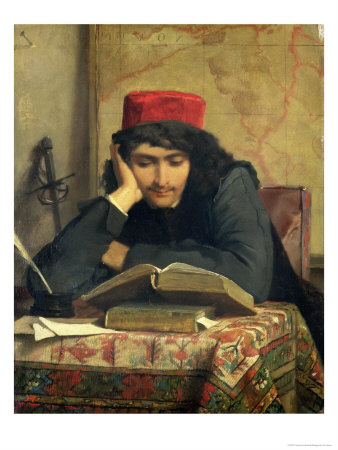
I really like my little medieval reader, because he’s the living spit of my character Carlito from a co-written story called Tears of Heaven.

Why do we co-write? If our co-writer loses interest we’re left with 95k [or more] worth of story that’s pretty much unusable. All respect to the writers who bravely go it alone and actually get stuff FINISHED!!

I’m particularly glad that one particular writer got stuff finished. Regency romance is a bit of a cliché in historical romance terms. There’s such a lot of it about and not always well executed. Not so this week’s recommendation – the Enlightenment trilogy by Joanna Chambers.


Click on the image to go to the book. I’ve linked to Provoked, the first in the trilogy, because I got in a muddle and bought Enlightened, the third book, first and had to buy both the others, naturally. This meant that once I’d started reading Provoked I couldn’t stop until I’d read both the others too and had 36 hours or so where I didn’t get much else done and finished with a mild squint and a big silly smile. So, Provoked first, ‘kay.

Provoked has one of the most riveting and unexpected first chapters I’ve ever seen in what I thought was going to be a romance. But, of course, this isn’t a romance. This is a historical novel, with some romance and a metric fucktonne of social commentary. Compelling fictional characters are inserted without a ripple into the murky pool of early nineteenth century politics, law and cross-border contention. I don’t think I’ve read ANYTHING set in Scotland that wasn’t a rehash of something already hashed up beyond redemption by Diana Gabaldon but this is firmly Scottish, looks carefully at the aftermath of rebellion and union and while a kilt makes its appearance it’s made clear that its presence is contentious. The social mores of the time are depicted accurately but with compassion and the hacks used to get around them don’t strain my credulity.

So much for the history. The romance appealed to me as well. David, young, highly intelligent and driven to make his mark as a lawyer despite the potential disadvantage of his need to occasionally slope off to find a cock to suck, is a brilliant character. He is clever with the sort of cleverness that makes him a little bit dumb where other people are concerned – not dumb, naive. He doesn’t always read situations well but thinks he does which is a great and very believable source of conflict with casual hookup Murdo. Murdo is older, wealthy, well connected and accustomed to being ruthless to get what he wants. He is a little arrogant, which strikes sparks off David’s prickly self made pride, but has hidden vulnerabilities that become more apparent as their story develops.

I say ‘their story’ because the romance between them is the thread that ties the three books together, but each book has a clear theme beyond the romance, addressing a social issues of the time. From the use of agents provocateur to interfere in labour disputes to the plight of abused wives, the historical content strikes me as right and oh it was such a joy to see something beyond star crossed lovers. David and Murdo have to be careful in the pursuit of their desires but for the majority of each book they have other important matters on their minds. I really respect characters who can put their own sexual gratification on hold while they deal with crucial problems beyond ‘who’s got the lube’.

Word of warning – I can’t say too much, because of spoilers, but PAY ATTENTION. It’s really worth it. Also either don’t buy all three in one go, or make sure you don’t have anything else to do/anywhere to go – you won’t want to put them down.

Read Full Post »

Saturday Recommendation

So many books! I’ve had a brilliant month picking up several terrific titles at the Meet in Bristol and getting a mountain of recommendations to add to my TBR pile. It occurs to me that one recommendation a week isn’t really enough! This week I’ve been bingeing on historicals – my favourite – but I’ve read some excellent Sci Fi as well.

Sometimes I pick up a book with no particular expectations and am surprised and delighted by what I read. Sometimes the title is much anticipated from an auto-buy author who has set a very high bar and the delight, while anticipated, is just as great. My recommendation today is one of the latter – Think of England by K J Charles.

KJ is best known for her Magpie Lord books, set in a Victorian England where magic is a tried and tested solution to many problems. Think of England also has a Victorian setting only this one is skirting the edges of that much beloved country inhabited by the larger-than-life heroes of Rider Haggard, John Buchan etc, where heroes have exceedingly stiff upper lips, never undo their collars even in the hottest weather and feel that just because a chap enjoys the company of chaps, other chaps shouldn’t be too quick to read anything into it.

That description fits Archie Curtis, nephew of the great explorer Sir Henry Curtis, damaged and grieving after an ‘accident’ that maimed him and killed his men and his – well not lover because Archie isn’t like that – but Archie has heard that the accident may not have been an accident at all and is investigating in an endearingly inept and gentlemanly fashion. The moral knots into which Archie ties himself are one of the joys of the book. As a complete contrast to our clean-cut hero is Daniel Da Silva, who speaks like a gentleman but is plainly not from the top drawer, dresses in a very bohemian fashion and is the epitomy of one of my favourite words “louche”. Yes, Daniel bothers Archie from the moment he first sees him and he should because Daniel embraces all the things Archie tries to ignore in himself and flaunts them, as his green carnation demonstrates. Instead of being a rock solid rather unimaginative military man he is a poet and not a poet who writes proper verses either. His work has meanings that are just out of Archie’s grasp, but Archie assumes that they refer to something disturbing and ‘not quite the thing’.

Of all people to be essential to the success of Archie’s mission, Daniel is the least likely, but how these two negotiate their way to being antagonistic partners, then lovers is another joy of the books. Together they face the appalling prejudices of the time, depicted with excruciating and necessary accuracy, social ruin, and both physical and psychological danger. The villains are plausible and loathsome, help arrives from unexpected sources, period appropriate solutions are found to age old problems.

I’m not going to say any more about it other that I LOVED it and am so glad that KJ is already writing book 2. To save you the bother of Googling, you can buy it here.

Read Full Post »

I haven’t done one of these for a long time – life has, as they say, been ‘interesting’ – but I recently read a follow up to books I have recced before so I thought I’d give it a mention.

I was very excited to hear that the next one in K Z Snow’s steampunky magiccy fantasy series was out and I’m delighted to say that my excitement was justified.

Machine by K Z Snow continued the story of the relationship of Fanule Perfidor, Eminence of Taintwell, and his ex-carnival snake oil salesman lover, Will Marchman, who has given up on the snake oil and now sells luxury items for personal grooming, with some time spent revisiting other amazing characters like Clancy Marrowbone, vampire, and Lizabetta and her cat, surely the most unusual healer and pet currently in fiction.

Life is proceeding pretty well until a strange wagon arrives at the carnival, then appears in various places around Taintwell, and the citizens begin to exhibit odd behaviours and in some cases disappear. The owner of the Spiritorium is implicated and Fanule has to find out who he is and what he’s doing.

Then epic stuff happens, happy couples are torn apart and everyone’s well-being spirals quickly towards the drain.

This is such good fun and fills in answers to some questions that had occurred to me in book one, Mongrel. Another thing I really enjoy about it is that the lives of the bit part players are treated with sympathy and there are some of that rare breed in M/M fiction – strong sensible female characters who are not interested in getting into either hero’s pants because they have their own thing to do. People in this world have flaws to overcome and conflicts to resolve beyond the main plot and that is as it should be.

But the main plot is compelling and exciting and I recommend this book very highly to any reader who craves a good sound plot and compelling characters.

Read Full Post »

Sometimes my Saturday recommendations are books that I picked up on a whim. Books that I read with a growing sense that I was seeing something wonderful and special unfolding before my eyes. Sometimes they are books written by well loved authors so I am fairly certain that I am going to like what I see. Sometimes they are books with which I’ve had a bit more to do, yet are still eagerly awaited.

This week’s book is one of the latter. I saw it at first draft stage and was blown away with it, and I can assure you that the final version is even better.


The Reluctant Berserker by Alex Beecroft explores a period of history for which the records are regrettably murky, but the art and the poetry are sublime. The centuries between the departure of the Romans and the flowering of the great Saxon kingdoms are called the Dark Ages and to modern eyes appear to be a time of savagery as the people teetered in the balance between Christianity and paganism yet there was enormous grace, sensibility and faith as well.

That spirituality is important to the story is evident from the opening line which could have been taken directly from Beowulf or the Dream of the Rood. In hearing a breeze bourn run of harp notes Wulfstan is doomed, although it takes him a while to realise it. There’s this gorgeous sense of melancholic inevitability about it all – man is whirled by his fate as a leaf on a stream – which may not sit well with a modern reader raised to believe that anything is possible if you put your mind to it but was part of life to our Anglo-Saxon ancestors. Another thing that may not sit well with modern readers is the prescriptive attitudes to sex but this is a serious historical novel rather than an historical fantasy and, as such, reflects the attitudes of the time.

Wulfstan is a typical warrior, massive, agile, aggressive, the elite of his band. He is valued by his lord for his ability and feared by his fellows for his sudden uncontrollable rages. His closest friend is Cenred, the only man who can safely approach him when in the grip of his ire. He takes pride in his status and only he knows his darkest secret, his shameful urge to be more ‘womanly’. This is a secret that can never be told. For Wulfstan to desire other men is acceptable – women are in short supply and prone to die in childbirth so taking a male slave or servant lad is a good substitute – but Wulfstan MUST be the one to do the taking. Any suspicion that he desires to be the one taken would ruin him. Naturally the suspicion arises, with tragedy as a consequence and Wulfstan is left with a terrible choice to make.

On the other hand, the beautiful, delicate scop [itinerant musician and poet], Leofgar, appears to be everything a man might desire as a yielding and compliant bed mate but is actually an assertive and pride-filled top. A scop is both despised and feared. He is dependent on charity for bed and board but if angered can make a rhyme to flay the bones from a man’s pride. To humble himself to another man’s desire is beyond Leofgar. Naturally he is placed in a position where he either has to bow or be broken.

How both men deal with their choices, their burdens, their persecutors, makes up the rest of a book filled with delicious details and fancies expressed in the flowing language of a scop. Other beauties are period appropriate yet strong female characters following their own minds, the innocent faith in the goodness of Mother Church, the acceptance of the power of the unseen world over man’s fate and that the villains, even the most cruel and abominable villains by modern standards, are obeying the dictates of their own social status or natures. I really admire that.

Read Full Post »

This weekend sort of crept up on me. I knew it was Saturday but forgot that I should be doing something special – specifically whooping about a particularly good book on my recently read list.

Better late than never, eh?

My choice this week is the first part of a 2 novel story that won Best LGBT Novel in the 2014 Rainbow Awards – Greenwode by J Tullos-Hennig.

Just look at that book cover!

I’m only halfway through the story – the other half is in Shirewode – but I am very impressed with it.

The premise is that in 12th century England the Norman conquerors were still trying to impose their punitive  Christian religion on the Saxon populance, most of whom had embraced it. However in isolated pockets the Old Religion worshipping the Holly, Oak and Ivy, The Lady, the Hunter, Maiden and Mother and all the other trappings of what we infer about pre-Christian Celtic religion. The Old Religion is viewed with hatred by the Christians and its practitioners are persecuted. There is also more conflict between the privileged nobility and their serfs, who are treated, or mistreated, as chattels little better than animals.

Enter Gamelyn Boundys, third son of the lord of Blyth, bullied by his brother and out of step with all around him. Rescued from the forest by Rob, a forester’s son and befriended by Rob’s family, Adam the forester, Eluned the wise woman and fiery Marion, Rob’s older sister, Gamelyn soon feels more at home with his inferiors than he does at home. Soon his hero wrship for Rob eges into something more setting up uge conflict as he blames Rob for drawing him into a deadly sin.

Rob too is conflicted. More worldly that Gamelyn he knows that he’s probably only something to do and that falling in love with Gamelyn would be a recipe for disaster even if Gamelyn wasn’t bound for the priesthood and rob hadn’t been dedicated to the Old Religion as the next Hunter.

This is a very complicated story. There are story threads to do with both religions, relationships between members of families, between Rob and Gamelyn, Gamelyn and Marion and conflict at every turn. Layer upon layer of danger is added and I sincerely advise you to buy Shirewode at the same time as you buy Greenwode or you run the risk of being left to grind your teeth unless you can get the other half of the story.

Let’s just say that Greenwode ends on a considerable cliff hanger.

I’ve seen a few criticisms that the story is hard to follow and I can’t deny that it is, but to anyone who was a follower of the Robin of Sherwood series in the early 80s the religious aspect is familiar and there are some lovely tender moments between Rob and Gamelyn.


Read Full Post »

As usual I’ve lost the plot a bit this week as far as signing up for stuff but here’s a Saturday Rec post anyway.

I’m a big fan of historical action stories, and of action stories in general. Until I found the growing M/M genre knocking on for 10 years ago now, I had never read romances – preferring Fred Forsythe or Patrick O’Brien to Loretta Chase or E L James – and I still have problems getting my head around the tropes. Some of the best stories I’ve read play all kinds of games with these ‘set in stone’ rules.

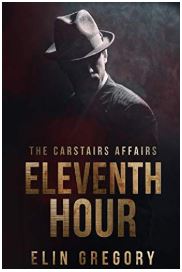
Because I know that I have problems with romances I scan the ebook sites very quickly ignoring all the naked torsos and cuddling contemporary couples, instead pouncing on anything with a gun on the cover, a suggestion of noir or a whiff of historical costume. The Boys of Summer went on my To Read List the moment I saw the gorgeous cover.

Boy, did I feel daft when I read the blurb and realised that it was a contemporary romance but actually it was that glorious thing – a twofer! As in two for the price of one.

The contemporary romance concerns David, a location prospector for the film industry checking out sites in the Hawaiian archipelago, assisted by Rick, a pilot, whose skill at the controls is the only thing between them and death when a tropical storm blows up. There’s action right from the first page and the pace continues, with quieter moments that allow the reader to catch up and realise just how much trouble the protagonists are in. Neatly inserted into the contemporary narrative is a slightly slower paced story set during the Second World War where another David and Rick carry out an exquisitely agonised courtship against a backdrop of code breaking and far too many sorties as a fighter pilot. This part of the book was beautifully done and impressed me very much – a clear 5 star read. Then we return again to the present with a greater sense of purpose and urgency.

How one story fits with the other would be a spoiler, as would how the past impacts on the present so I’ll say no more about it other than that it was a damned good read and kept me entertained throughout.

Read Full Post »

« Newer Posts