
My guest today is Ally Lester – writing as A L Lester – author of the Lost in Time series and currently celebrating the release of her latest novella, Inheritance of Shadows.
Thank you for joining us today, Ally and answering my questions.
~~~
Elin: Can you tell me a little about yourself? For instance, do you have to have a day job as well as being a writer?
Mr AL and I are full-time carers for Littlest, who is eleven and severely disabled. I used to be an IT geek. Then I taught people office skills for a bit. Oh, and did spiritual healing. And then I worked in the audio-visual industry with Mr AL for a while, doing lights and powerpoint and stuff for conferences. I quit that when I had babies because people got cross when I climbed ladders whilst pregnant. And then I started a chicken breeding business and had a market stall selling eggs. I gave that up when Littlest began to need more care. Plus I started having stress-related seizures and couldn’t drive any longer.
Elin: When you aren’t writing, is there any other creative activity you enjoy? Have you ever written about it?
I do fibre-craft stuff when I have the time and head-space. I knit (quite well) and I spin (very badly). I also needle-felt and sew, but it’s a bit hit and miss. And, erm, I brew beer? And I like to bake. All of this is very dependent on where I am in my head, though. I try and only start small projects these days because I run out of puff and they get abandoned. Oh, and I have a permaculture garden, that’s creative, too – it’s a slow process, but I’m gradually trying to make our garden self-maintaining and also food-producing. It’s a constant battle with the nettles at the moment, so it doesn’t feel very creative or nurturing, just a daily slash-and-burn battle.
 Elin: Can you name any author/authors, past or present, who have been a great influence on your work?
Dorothy Dunnett, for the meticulous historical research in her Lymond series – I’m listening to them on audiobook at the moment! Ursula Le Guin, for her wonderful world-building. And Josh Lanyon was the first gay romance author I read. I love her style.
Elin: What are you reading? Something to be clutched to the bosom or tossed aside with force? Fiction or non-fiction? Recommendations please.
Ooooh! Well. I’ve actually just read Kaje Harper’s new release, Changes Going On! I loved the first in the series – Changes Coming Down – and have been waiting for this to drop on to my ereader. It’s a gay menage, which with some authors is all about the sex and not about the story, but this is NOT that. It’s about a cop, a rancher and an ice-hockey player (again, ice-hockey romances not my thing usually) and how they all fit together. There are murders, too, which I like a lot in my reading. Once I’d finished that, it prompted me to go for a massive Kaje re-read, so I have also read her Life-Lessons duology (closeted cop, teacher) and am now reading Nor Iron Bars a Cage, which is set in a fantasy world with a mage as the hero. They all happen to have gay MCs, but I read all sorts of books with queer protaganists – Ada Harper, C. L. Polk and Allie Therin are all hard recommends. Also Melissa Olsen’s books – the relationships are straight, but it’s so plot-driven that they sucked me right in.
Elin: Are you a plotter or a pantser?
Pantser. I’ve been trying to be more of a plotter, but honestly, everything just falls apart. I need to write about 30k words, just splurged on the page, and by the time I’m done with that, it’s become apparent to me what’s actually happening in the book and I have a plot to work with. I write using Scrivener, which lends itself to small scenes I can pull around to where they fit.
Elin: Do your characters arrive fully fledged and ready to fly or do they develop as you work with them?
Definitely develop as I work on them. I suppose I feel that I’m discovering more about them as I go – it’s not that I have to make them up. I just discover what they would do as I’m writing each scene I throw at them.
Elin: Do you have a crisp mental picture of your characters or are they more a thought and a feeling than an image?
Definitely more a thought and feeling. And a smell, sometimes, which is weird, because I don’t actually have that much of a sense of smell in my real life.
Elin: Do you find there to be a lot of structural differences between a relationship driven story and one with masses of action?
I find it very hard to write purely relationship driven stories, so I don’t! I find them a bit boring to read, too, so I think they’re just not my thing. Several people have said to me that I don’t actually write romance, per se, because there’s such a lot of plot going on in my stories. I think with relationship-driven stories so much of the conflict is internal that it’s hard to do them well. It’s possible to have a lot of ‘telling’ going on rather than ‘showing’, which I think makes the story slow – unless you have a lot of misunderstandings and people being horrible to each other etc, which is difficult to make realistic. I am the person who spent all of the school production of Othello muttering ‘just ask her about the handkerchief, just ask her about the handkerchief’. I find a lack of communication between characters annoying rather than a sympathy point for them!
Elin: Villains – incredibly important in fiction since they challenge the main protagonists and give them something to contend with beyond the tension of a developing relationship. What sort of villains do you prize? A moustache-twirling nightmare or … ?
I’d like a tortured villain, if you’re going to make me choose, please, thank you. Someone who is a baddie because of their circumstances or their inner turmoil or because… just a random example… they have been connected to someone else by a magical accident and cannot get free.
Elin: What are you working on at the moment? Can you discuss it or do you prefer to keep it a secret until it’s finished.
I can discuss it! I’m working on a story between a disabled farmer and a disgraced stockbroker, set in the same place as Inheritance of Shadows, but in the 1970s rather than the 1920s. It’s sort of a sequel. But it’s not, really. I loved the farm-setting so much that I wanted to re-visit it. I’m not sure if it’s got magic in it yet though. I’m still in the frantic-pantsing stage.
Elin: Could we please have an excerpt of something?
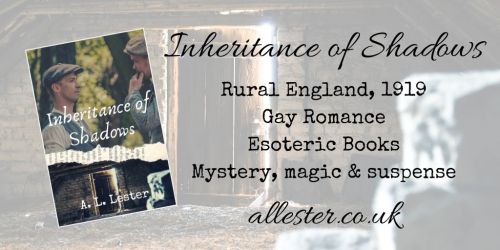
 You may! Here is an excerpt from Inheritance of Shadows. This is my new release – it’s a 35k stand-alone novella set in the Lost in Time universe, although readers who have come across other books will recognize little things that carry across from different books. The first 7.5k words is a tidied up version of The Gate, which is the first thing I wrote set in the universe and which is available free. I then wanted to find out what happened to Matty and Rob after the end of the story- and this is the result.
It’s 1919. Rob and Matty both return from the trenches only to find Matty’s brother dying of an unknown illness. And Matty’s looking sicker and sicker. The answer seems to be in the esoteric books Arthur left strewn around the house.
It’s taken them more than a decade to admit they share feelings. They are determined that nothing will part them. What is Rob prepared to sacrifice to save Matty?
CHAPTER FOUR: Breaking the Cypher
“I think I’ve got it,” Rob murmured, one Saturday evening in November as they sat on either side of the fire in the parlour. He had a notepad on his knee and was transcribing from what Matty thought of as the Himalayas book, with the coded text and sketch-maps. It had been raining all day and they’d been hauling muck from the heap behind the byre to put on the fields of oat stubble. It had been a relief to come in and have a bath before they’d eaten, and they were now relaxed and tired.
Matty paused in his own reading to look over at Rob. He was still working on the green book himself, on the pages of what he thought of as spells. Some of them were in reasonably plain if old-fashioned English, some were in languages he could make a decent stab at with a dictionary, and a few were in a completely incomprehensible scrolling script that he couldn’t place, even after two months of searching. “Got what?” he asked, intelligently, pulled from his fugue.
“The cypher. There’s a bit later on, toward the back, that’s a translation, I think. It looks like I might be able to make the rest out from there.”
Matty rose and went over to sit on the arm of Rob’s chair. He often sat like this, reading over Rob’s shoulder as they puzzled out some piece of nearly indecipherable script. They were moving forward slowly with understanding what the books said. There were many others—piles of them all around the floor. Matty had ploughed his way through Arthur’s well-thumbed edition of The Golden Bough and agreed with Rob that it was the biggest load of cobblers he’d ever come across, neither of them having much use for either magic or religion. There were history books, psychology books—Mr Freud was another load of perfect bollocks, Matty thought, despite Rob’s interest—and books on different languages and people and places. As they had sifted through them all during the dry autumn, it had become clear that the focus of the collection was the pair of antique, handwritten books they had initially identified. Arthur had gathered the rest of his library in his quest to understand those. Now Matty and Rob had taken on his mantle.
Matty often wondered how long Arthur had been investigating this. Was it something he’d come across during his time in London? He’d gone from Oxford to work at the Evening Trumpeter when he’d gone down in 1897. He had travelled abroad to cover the war in the Sudan. He’d been to Afghanistan to write about the Pathans for the same paper. “Perhaps he picked up the brown book in India,” he mused, out loud. “That would make sense, wouldn’t it? A lot of the notes are about that area.”
“Perhaps,” Rob agreed. “I’m not sure it matters, though. Look at this.” He pointed to an untidy page of writing on the flyleaf at the back of the book, scratched in pencil. It contrasted sharply with the reasonably neat pages of the rest of the notebook. He recognised the hand as the one filling the second half of the book. “Here, look, it’s a translation of the cypher.”
“I thought you said it was Trench Code,” Matty asked.
“Sort of. It’s a cypher, really. Trench Code is impossible to crack without a code book—you can guess, but really, unless you know what the words are supposed to stand for, you’re stuck. A cypher, though. You can crack a cypher, if you’re lucky. Even if you don’t have the key.” He drew his finger down the pencil-covered, discoloured page and Matty became a little distracted, following its path. “It’s not a direct key, this here. But I think that it’s a translation of an earlier bit of cypher. This one, here.” He flipped back to a page much earlier in the book, a left-hand page, facing the map of the cave system on the right.
“Here, look. This grid here has pencil marks overwritten. Very faint.” He pointed. “And I’ve just realised…the first few letters on this page…” he flipped back to the flyleaf at the back of the book, “correspond to them. Which gives us somewhere to start.” He grimaced up at Matty. “I’m kicking myself. I’ve been thrashing through it for weeks and not getting anywhere, and it was here all the time. It looks like someone tried to rub them out on the first page, once they’d written it out in longhand.”
Matty looked. “Yes, I can see the marks. So, what does it say?”
All the links!
Buy links / https://books2read.com/inheritanceofshadows
Website / http://allester.co.uk
Facebook / http://facebook.com/ALLesterAuthor
Twitter / http://twitter.com/CogentHippo
Instagram / http://instagram.com/CogentHippo
 Scent of Lilies grew from my first ever published short story Ninufar’s Kiss which was all about Tekla. I’d been listening to Bulgarian folk songs (the amazing voices of Le Mystère des Voix Bulgares which still gives me goosebumps) and the characters just turned up (as they do). I’ve never been to Istanbul (Crete is the closest I’ve come) but a visit some years ago to the Chapelle des Moines in Burgundy with its wonderful 11th-12th century Byzantine frescoes by an unknown team of artists inspired me to do research as to how the artists worked. The main protagonist of my fantasy trilogy The Tears of Artamon, Gavril, is a portraitist (his mother Elysia is also a painter) so I seem to be fascinated by artists and the magic they wield.
 It was late afternoon and the sun was already dipping westwards, flooding the isthmus with a dazzle of golden light. Damian turned to gaze upwards at Saint Thekla: a large tiled dome, the intricate masonry beneath sun-gilded from grey to rich ochre.
 Alan Hollinghurst’s The Line of Beauty is a wonderful book – and I wish I’d written it! It’s set in 1980’s London, and recalls a brutal time in Britain’s history. But Hollinghurst writes it with great wit and pace. It’s not just a damn good plot, it’s also a great piece of social history. His novel The Stranger’s Child is also a very good piece of social observation, and a very complex structure, set in multiple historical periods. Hollinghurst handles the switch between periods deftly and with great lightness of writing.

 Blurb:
 I’m re-reading Holding the Man by Timothy Conigrave. I’d read it a few years ago, and when I saw they’d made a film of the book, I worried they’d spoil it. Not at all. If you see the film, or read the book, be ready to weep buckets!


 Villains have got to be credible, so they need reasons for being bad. No one is all good, or all bad.


 I absolutely love Shakespeare and am always pleased when his work is taken as a starting point for other fiction. So this week and next I’m delighted to be hosting th authors who contributed stories to A Summer’s Day, an anthology of Shakespearean stories with a bit of a twist. As if that wasn’t exciting enough, all the profits from sales of this book will go to the It Gets Better project!
 Rory Ni Coileain majored in creative writing, back when Respectable Colleges didn’t offer such a major, so she had to design it herself, at a university which boasted one professor willing to teach creative writing, he being a British surrealist who went nuts over students writing dancing bananas in the snow but did not take well to the sort of high fantasy she wanted to write. She graduated Phi Beta Kappa at the age of nineteen, sent off her first short story to an anthology being assembled by an author she idolized, received one of those rejection letters that puts therapists’ kids through college (Ivy League), and found other things to do, such as going to law school, ballet dancing (at more or less the same time), and nightclub singing, for the next thirty years or so, until her stories started whispering to her. Now she’s a lawyer and a legal editor, and the proud mother of an about-to-graduate filmmaker, and is busily wedding her love of myth and legend to her passion for m/m romance.

 My guest today goes under the name of Ruff Bear in most places though, as so many of us do, he has another name for those boring administrative things that aren’t nearly as much fun as being a creator of truth and beauty. Sadly Facebook doesn’t have much truck with truth and beauty and insists on the workaday name so I’ve invited Bear to my blog so he can talk about the real him for a while.

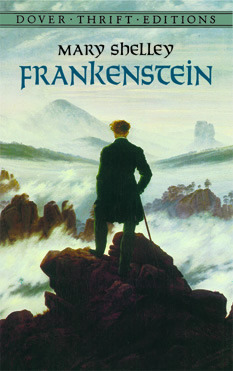 Eventually I am going to get around to erotica in the D.H. Lawrence and Henry Miller sense. I can’t see myself writing horror, crime, or anything with a lot of blood and violence. I admire 19th century horror novels like Frankenstein and Dracula, but the horror isn’t the creatures but how people reacted to them.
 Put together your ideal team of men/women – drawing from all and any walks of life, fictional or non-fictional – who you would want to come to your rescue if menaced by muggers/alligators/fundamentalists?
 One day the boy’s mother instructed him to make sure he said goodbye to his friends after they were done playing in the fields. Octavian couldn’t explain why he was leaving, only that his mother said they were. It wasn’t too unusual for a family to move from a community since opportunities came and went. Still, so far in their young lives, Octavian’s friends had only seen off one other, a girl who left for the interior when her mother was needed at a family cattle ranch when her aunt could no longer manage the place alone. When he said his farewells, the boy with long, bright auburn locks did not know it would be more than two decades before he saw another person less than seventeen years old.
 Bear was raised in the Baltimore-Washington area. He has lived in the Albany, NY, area for 20 years. He has been writing since the age of 13 and had his first work, a poem, published at 17. Bear has worked 30 years in higher education as a professor of political science and a student success specialist. He has lived overseas in China, Hong Kong, Lebanon and Saudi Arabia.

 In your Atlantis series I noticed many familiar names and terms but all had been treated in a unique way. How difficult was it to come up with new ways of handling the old concepts and were you ever tempted to cut corners and go along with Plato?


 After escaping from a flood that buried the aboveground in seawater, a fractured group of boys contend with the way ahead and their trust of an underground race of men who gives them shelter. For sixteen-year-old Dam, whose world was toppling before the tragedy, it’s a strange, new second chance. There are wonders in the underworld and a foreign warrior Hanhau who is eager for friendship despite Dam’s dishonorable past.

 In other projects, though, character and situation arrive together: “What if a person like this encounters a problem like that?” The plot/situation is of no interest to me unless I care about the character in the middle of it, and just having an interesting character means nothing until he has a story platform to stand and act on.
 What an interesting array of threats! Let me draw from characters I’ve written.
 I hope I never write what I would call a villain, as all I can think of is Snidely Whiplash tying some fair damsel to the railroad tracks. His morality is one-dimensional. Antagonists can be deadly, but in my mind should be more complex when it comes to the morality of their actions. In general, I’m most interested in the antagonist who is convinced he is doing good even as he commits evil—like burning someone at the stake, convinced it’s the only way to save their soul. That’s very compelling to me.


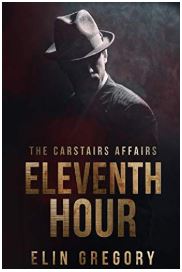



 Elin Gregory