Feeds:
Posts
Comments

Posts Tagged ‘comfy chair’

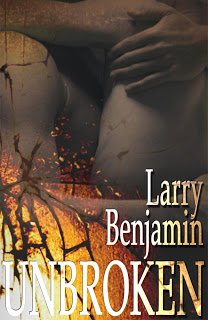
comfy chairMy guest today is Larry Benjamin, Bronx-born wordsmith for whom writing is a way of life. Author of romance What Binds Us and short story collection Damaged Angels, Larry has agreed to visit today to talk about his new release Unbroken, a book with a very special meaning for Larry. I’ve been lucky enough to read it and can say that it impressed me very much.

Thanks, Larry, for visiting and for answering my questions.

###

Elin:  Can you tell me a little about yourself? For instance, do you have to have a day job as well as being a writer?
Larry:  While I’ve always been a writer—that is, I would write and stick my stories in a drawer (or later, a folder called “Larry’s writing” on my computer) —I got serious about it as a career a few years ago when both my partner and I ended up unemployed at the same time. I began to panic thinking I’d never get another job which lead me to wonder what else I was qualified to do. I dusted off the manuscript for What Binds Us and I was on my way. Returning to writing was like returning to a first love long lost.
Yes, I have a day job. I work in Corporate communications for a global chemical company. So writing is both my vocation and my avocation.

Elin: When you aren’t writing, is there any other creative activity you enjoy? Have you ever written about it?

Larry:  Besides writing, I’m absolutely passionate about houses. We’re 6 years into the 5-year renovation of our current house (the 5-year plan on our previous house actually took eight). And most weekends you can find us attending open houses in our favorite neighborhoods. Realtors don’t even make us sign the visitor’s book anymore.
Readers can pick up on my obsession with houses and their furnishings in my descriptions of both in my books.

Elin:  What are you reading? Fiction or non-fiction?

Larry:  I’m currently reading Gerald Durrell’s My Family and other Animals, which is unusual for me because generally I tend to stick to fiction as I find reality to be overrated and often grim. I’m loving the book, though, because the story is quite hilariously told and the writing is very fine.

Elin:  In that crucial inspiration stage of a new story, for instance Unbroken, which comes first? Plot, situation or character?

Larry:  Because my stories are heavily character-driven the characters tend to come first. However, I started writing Unbroken, just after I came across a tweet that asked: when was the moment you first knew you were gay? For me the moment occurred when I was in seventh grade. I was 12. He was the new kid. Jose. One look at him and I knew, absolutely knew I was gay. So in the case of Unbroken, the situation came first. Everything else was built on that defining moment.

Elin:  Do your characters arrive fully fledged and ready to fly or do they develop as you work with them?

Larry:  It depends. Dondi in What Binds Us arrived in my head fully formed and he never really changed. Unbroken spans 40 years. Lincoln, the main character, is first introduced as a 6-year-old so he definitely developed as I wrote. Same with the other main character, Jose. Lincoln first meets Jose when they are both twelve. He is the new kid in school so a complete unknown. As the story progresses, Jose’s personality is revealed and we watch him grow and mature as struggles to understand himself and the world around him. For me the most astonishing character in Unbroken was Jose’s sister, Maritza. She was meant to be a very minor character but she kept nagging me and whispering her story. I was routinely getting up in the middle of the night and writing out more of her story, which surprised me at every turn. In the end she became the first fully formed female character I’ve ever written.

Elin:  Do you have a crisp mental picture of them or are they more a thought and a feeling than an image?

Larry:  I generally know what the characters look like but little else at the beginning. I have a feeling for who they are as people but I find by relaxing and listening really hard they will tell me who they are as they reveal their story to me. I don’t outline, or plot out my stories in detail, in advance of writing, I just sort of write. For me writing is an organic—and chaotic—experience.

Elin:  Is there any genre you would love to write, ditto one you would avoid like a rattlesnake?

Larry:  You know when I was submitting Unbroken for consideration for publication, I had to identify its genre. That was a struggle because I tend not to think about what genre I’m writing in. I just write because I have a story I want to tell. Unbroken is part gay romance, part coming of age novel, part love letter to the boy I fell in love with at twelve.
The other day, I came across a reader’s review of What Binds Us and she said, “Yes, it’s love story but really so much more than that. More like a life story.” A life story. I absolutely love that description.

Elin:  When you were writing Unbroken, was there a point where you felt you should pull back a little because you were putting too much of yourself into it?

Larry:  Oh yeah. I tend to reach that point with all my books. My books are all fiction but they are firmly rooted in my experiences. I’m an emotional writer and that emotion is grounded in truth.
With the writing of Unbroken, I had to revisit my past: the bullying, my parents’ disappointment, the innocent longing for a boy I barely knew─It was a painful part of my history and documenting it was to revive that long-forgotten pain, to show a side of me—part hopeful, part stupid—I wasn’t sure I wanted anyone to see. In the end the struggle to share the truth won out.
When I set out to write the book, I didn’t want to just tell the story of one boy’s love for another, I wanted to share details of a first crush and what it’s like to discover the world thinks you’re wrong in that love, thinks that you’re broken. So yes there’s a lot of me in Lincoln, a lot of my own truth in Unbroken. And I wouldn’t have it any other way.

Elin:  Put together your ideal team of men/women – drawing from all and any walks of life, fictional or non-fictional – who you would want to come to your rescue if menaced by muggers/alligators/fundamentalists?

Larry:  That team would consist of William Morgan—Gar—from my friend Andrew Q. Gordon’s remarkable fantasy novel, Purpose. Gar is strong, extremely rational and practically bullet-proof. Plus he can read and manipulate minds. Second on the team would be Toby, my 9-year old silky terrier.

Toby the Fierce

He’s small but fiercely loyal and extremely protective. And finally Matt Damon. He was, after all, Jason Bourne in the Bourne trilogy; I’m sure he picked up some useful skills from playing that part. Plus he looks like…well…like he does. 😉

Elin:  Villains are incredibly important in fiction since they challenge the main protagonists and give them something to contend with beyond the tension of a developing relationship. What sort of villains do you prize?

I prefer villains who aren’t purely evil, who have some trace of humanity. I also like to believe that every character can become a villain for a moment in a particular situation. In Unbroken, there are many, many villains but only in the sense they give the main protagonists something to contend with, they are the people Lincoln and Jose must battle in their journey to be their authentic selves—parents and petty bullies. And for that reason the villains are unexpected, people well meaning in their own way but narrow minded, some are cruel, others, afraid.
Sometimes though, at least for me, villains aren’t people. In What Binds Us, the main villain was the HIV virus. In Damaged Angels the villain was drugs and desperation and mental illness. In addition to the “people villains” in Unbroken, there is also the villain of internalized homophobia which can makes Lincoln believe he is broken.

Elin:  What are you working on at the moment? Can you discuss it or do you prefer to keep it a secret until it’s finished.

Anyone who knows me knows I am terrible at keeping secrets. When I’m working on something I start talking about it right away. I’m not writing anything at the moment. When I finish a book, I find I need a “fallow” period to rest, to recover, to just be. Then at some point, an idea will form, or a character will introduce himself and I’m off.

Elin:  Could we please have an excerpt of something?
Here’s an excerpt from Unbroken

Brainiac
They hurled words like stones: “Brainiac. Sissy. Faggot.”
I sat on the ground, surrounded by a circle of boys bigger and tougher than I. They’d taken my glasses so I couldn’t see. I could only sit there helplessly, trying not to cry, trying not to hear the names they called me.
I let myself go silent in defense, refusing to acknowledge the hateful words: Brainiac. Sissy. Faggot. I refused to acknowledge their hostility, this hostility, this constant hostility, which seemed to be driven less by the fact that I was almost certainly gay, than by the fact I had never denied their accusations. I knew instinctively that to deny, to lie, was to agree they were right, I was wrong, I was broken. That I would not, could not, do.
Looking back, I realize I’d let them, those savage boys whom I did not know or care about, silence me, take my voice away. It would take years, but I would find my voice. I would learn to make myself heard over the sounds of war.
“Hey,” Jose shouted suddenly. “Hey!” I couldn’t see him through the circle of boys, but I recognized his voice, that deep, thunderous rumble.
“Come on,” I heard Elsie say. “It’s just that faggot. This happens to him all the time. He’ll be fine.”
She’d known me since fourth grade yet still, to her, I was “just that faggot.” “My name is Lincoln,” I wanted to shout. “You’ve known me since fourth grade.” Instead I remained on the ground fighting new tears.
Jose pushed through the circle of boys. “Leave him alone.”
He must have seen my raw, naked face for he turned to the boy holding my glasses. “Are those his?” he asked, pulling them out of his hands. “Get lost!”
The boy, surprised, shrugged as if it made no difference to him, and he and his posse of tyrants turned and walked away.
Jose crouched beside me; bouncing on the balls of his feet, he looked at my scattered books, my knapsack open, empty. His eyes went soft, dark with concern. He turned, and said something to Elsie. Then to me, “You okay?”
I nodded, tried to smile, cried instead.
“Hey,” he snapped.
“What?” Elsie popped her gum, stared at him.
“I said, give me a tissue.”
She sucked her teeth, reached into her purse and handed him a single tissue as if it were her last dollar. He glared at her, dark eyes flashing. She reluctantly handed him a handful more which he gave to me. “Dry your eyes and blow your nose,” he instructed me.
I did as I was told.
“You okay?” he asked again, handing me my glasses. I took them from him, put them on.
“Better now,” I said trying to smile.
The boys gone, Elsie moved closer, hovering at the edge of our interaction. Her eyes darted around; she looked everywhere but at me. She appeared less concerned about returning danger than about witnesses to this.
“Okay,” Jose said. “Let’s get your books, and we’ll walk you to the bus stop.” He glanced at Elsie who said nothing.
At the bus stop, Elsie sulked on a bench, again looking everywhere but at me. Jose talked to me of little things: did I understand that Shakespeare passage we’d read in English today? Why does the cafeteria always smell of fish?
Finally the bus came and we were each released from his prison.
“Thanks,” I said as the bus drew to a halt. I was reluctant to leave him, my dashing young hero, but happy to put the day’s events behind me.

###
Unbroken

Blurb:
My parents, unable to change me, had instead, silenced me. When they’d stilled my hands, they’d taken my words, made me lower my voice to a whisper. Later I remained silent in defense, refusing to acknowledge the hateful words: Brainiac. Sissy. Antiman. Faggot.

Lincoln de Chabert’s life is pretty unremarkable until he comes home from kindergarten and announces he will marry his best friend, Orlando, when he grows up. His parents spring into immediate action, determined to fix him―his father takes him to baseball games and the movie “Patton”―igniting an epic battle of wills as Lincoln is determined to remain himself, and marry whom he chooses, at all costs.

Unbroken is available now from Amazon in paperback and Kindle. Barnes and Noble in paperback and Nook, and from Smashwords in all ebook formats.

You may follow Larry here:
Facebook: https://www.facebook.com/AuthorLarryBenjamin
Twitter: https://twitter.com/WriterLarry
Blog: http://authorlarrybenjamin.blogspot.com/

Read Full Post »

comfy chair When I heard that my good friend Dianne Hartsock had written an historical romance I couldn’t wait to plonk her down in my chair again and ask her a few searching questions about her work.

Thank you, Dianne, for being here today to talk about your latest release, Wee Willie Winkie,  and how you came to write it.

~~~


Elin: Hello, Dianne

Dianne: Thank you so much, Elin, for having me back on your wonderful blog!

 Elin: What was it about the nursery rhyme “Wee Willie Winkie” that sparked your interest?

Dianne: When I was little, maybe five or six years old, I remember we had a huge illustrated book of Mother Goose Rhymes. Oh gosh, you’d have to sit on the couch with it in your lap to hold it! My favorite story was Wee Willie Winkie.

Or should I say, my favorite picture was the one that went with the rhyme. It was of a young boy wearing a flowing white nightgown and carrying a tiny lantern. He was running somewhere, blond curls flying behind him. He had such a mischievous grin on his face!

When Breathless Press put out the submissions call for Naughty Nursery Rhymes, I thought instantly of Willie’s smile. That little imp probably got into all kinds of trouble growing up! I began to think of the wild escapades he might have lead his friends into, and so began my story.

 Elin: I know that you have previously written fantasy and horror. Is this your first foray into historical?

 Dianne: Yes it is, and the funny thing, is that when I was writing the story, I never thought of it as an historical piece. It was a straight up m/m erotic love story that just happened to take place in the 1880’s, in keeping with the white nightgown I remembered in the picture. When men still wore nightgowns. Or at least I think they did. Not that I spend my time picturing men in or out of nightgowns…never mind.

Elin: Was it a very different writing process?

 Dianne: It was a little different, but also a lot of fun. Since I mostly write contemporary stories, there was more research involved with Wee Willie Winkie. Also, I had to make a reference to the nursery rhyme somewhere along the way, when with my other stories I usually just start writing and see where we end up. I’ll have a pretty good idea of the beginning, the middle scenes, and how I want the story to end, but things always seem to get a little complicated along the way. In Wee Willie Winkie, some of the things that happened to Fredrick in the course of the story, I hadn’t thought to put in until a bit of research sparked the scene. I love when that happens.

 Elin: Did you find the inevitable research onerous or fascinating?

Boston Harbour in the mid nineteenth century

Dianne:  I enjoy research for its own sake, and with Wee Willie Winkie I had the chance to delve into the politics of Boston and Newport in the late 1800’s. I had the fun of researching the merchant vessels of that time. Many merchant lines had already converted to the steam engine, but that is so unromantic! I had to have the Wilkerson’s still use sailing vessels.

While researching I also stumbled upon the fact that shanghaies were still being carried out. Scary stuff. Some poor guy would get knocked out in an alley or somewhere when they were alone, then would wake up on a ship far out at sea and made to work or starve. They may not see their home again for a good year, if ever. I also got to dig through old photos of Boston Harbor at that time. A bit different than modern days!

Okay, I could go on like this ad nauseam. Like I said, I enjoy research for its own sake. The fact that it helps with my writing is a plus.

Elin:  Without Aiden is a very different atmosphere to Wee Willie. Did you find it a big adjustment to go from one to the other?

Dianne:  I was actually in the middle of writing WITHOUT AIDEN when I set it aside to write WEE WILLIE before the deadline for submissions came and went. While I did have to get into a different mindset for WEE WILLIE, it wasn’t extremely hard. I’m a big fan of romance novels written between the 1880’s-1920’s and have an extensive collection of them. When I sat down to write WEE WILLIE, I was able to take the feel of these love stories and capture it in my own romance. At least, that’s what I attempted.

 Elin: Do you prefer writing contemporaries to your other genres?

 Dianne: I wouldn’t say that I prefer it, but it is the easiest! To me, writing a contemporary story is like telling of something that happened to a friend just the other day. Or retelling a story a friend told me about a friend of theirs who had such and such a thing happen. The story lines seem to flow naturally and easily without too much effort on my part. I don’t have to try to imagine what their world would be like. I’m living it.

On the other hand, writing in other genres is a challenge, and I do like to push my limits as a writer, see if I can make a certain scenario work. Is it plausible? Can I make the magic believable? Or, in the case of the historical, are my facts straight and are my characters acting in the fashion of that time? I have a short sci-fi story on my list of things to write this year, but it’s the science that’s holding me back. Definitely a challenge! *rubs hands together* Time for more research!

Elin: What’s next? What are you working on or would you sooner keep it a big secret?

Dianne:  Oh gosh, let’s see… It seems that at the moment I have four different projects I’m juggling. I have edits due on another short story for an anthology with Breathless Press, this time based around the nursery rhyme ‘Old McDonald’s Farm’. I’m 7k into a new contemporary romance that I’ve had to put aside—again—to work on the anthology. I’m 9k into a novel I’m writing as the sequel to my psychological thriller ALEX. And I’ve also started writing a Free Read on a friend’s blog, adding between 700-1000wds a week. Which you can find here! *wink* http://leatherandlacereads.blogspot.ca/search/label/Stuck%20on%20Rewind

Elin: Can we have an excerpt of one of your new releases?


WEE WILLIE WINKIE


Willie has met an old flame, but is he willing to give up the decadence of Boston society for the man he loves?

For the past three years William Wilkerson has led the life of the privileged rich. Head of his father’s shipping business, Willie indulges in the pleasures of Boston’s fine young men to his heart’s content. That is, until he meets Fredrick, the one man who has captured his heart, again.

As his former tutor, Fredrick has been declared off limits by William’s father. Fredrick also believes he’s beneath the attention of Wilkerson’s heir. Willie disagrees, but is he willing to throw away rank and privilege for the man he loves?


Excerpt:


Fredrick held up his glass and stared at the candle’s flame through the amber liquid. He took a sip, savored the rich, biting taste on his tongue. He welcomed the burn down his throat. This was the very last drink he could afford, and he had to make it last.

A giggle erupted from the booth in the corner, the one whose curtains were drawn against curious eyes. A smile tugged at Fredrick’s lips despite the dire state of his wallet. The laugh had been carefree, joyous, naughty. Fredrick shifted on the cushioned bench. Only a few straggling customers remained in the dining room. He wondered if any of them would notice if he shifted his cramped cock as it throbbed in sympathy with the bright laughter.

Rather than risk it, he watched the fruit vender outside the window beguile a customer. Another giggle and stifled moan swiveled his attention back to the corner. A silk-clad foot and slim calf peeked beneath the curtain. He grinned even as the delectable sight emphasized his own loneliness. It had been far too long since he’d had someone in his bed.

“Excuse me. Sir?”

Fredrick looked up, distracted from his memory of lush lips and white skin and wide, hazel eyes, and blinked at the stout innkeeper at his elbow. “Yes?”

A frown fleeted across the man’s homely face at another bout of laughter from the corner. “If they’re disturbing you, I can have Wee Willie take his guest upstairs. Excuse me, I mean Mister Wilkerson.” The man broke off, flustered by the slip of the tongue.

Fredrick’s heart leaped on hearing the name mentioned. Is William really here? How could that be? The innkeeper coughed, and Fredrick frowned at the intrusion into his thoughts. The man was so damned serious about such a minor indiscretion. “They’re no bother. In fact, I’m almost done anyway.” He lifted his nearly empty glass. Hearing a shout, they looked over in time to see a young man tumble through the curtains onto the floor. Fredrick caught a glimpse of red hair and an embarrassed cheek before the gentleman crammed a hat on his head and strode passed them, face averted. The innkeeper shrugged and followed, likely to be sure he paid for his drinks.

Fredrick stared at the silk-clad foot still protruding from the parted curtains. He loosened his hold on his glass but had no way to stop the wild hammering of his heart. Before he lost his courage, he stood and swallowed the last of his brandy, then walked the short distance to the booth.

A grin tugged the corner of his mouth at his eagerness. It had been three years, after all, and they’d parted in anger. Would William acknowledge him? His hand trembled as he drew aside the heavy curtain and allowed his gaze to travel up the silky hose to bright blue trousers. Blood heated his face when he found the laces undone at the waist and the silk shirt open to expose white skin and rosebud nipples.

A sigh brought his gaze up to the pretty face that stirred his dreams. Rich brown curls surrounded lovely hazel eyes and full, pouting lips. He groaned when a delighted smile revealed the even, white teeth that had nipped his collarbone on more than one glorious occasion. “Freddie, is it you?”

~~~


Thank you, Dianne, for being such a good sport.

You may buy Wee Willie Winkie from Amazon and All Romance eBooks  and you can follow Dianne at the links below.

Blog: http://diannehartsock.wordpress.com/

Facebook: http://www.facebook.com/home.php#!/diannehartsock

Twitter: http://twitter.com/#!/diannehartsock

Goodreads: http://www.goodreads.com/user/show/4707011-dianne-hartsock

Amazon Author Page: http://www.amazon.com/Dianne-Hartsock/e/B005106SYQ/ref=sr_ntt_srch_lnk_1?qid=1361897239&sr=8-1


Read Full Post »

comfy chairMy guest today is Lisa Henry, resident in Australia but her imagination roams the world and the genres from contemporary drama to ancient history. Her work has received glowing reviews and has been picked as The Romance Reviews top picks.

Thank you very much, Lisa for agreeing to answer my questions today.

null

Elin: Do you have a crisp mental picture of your characters or are they more a thought and a feeling than an image?

Lisa: I like to know what makes my characters tick, but I never have more than a vague idea of their physical descriptions in my head. I’ll write sticky notes about eye colour, hair colour, and who is taller than who (otherwise I’d get mixed up when it comes to love scenes) but that’s about the extent of it. When I read I usually like to fill in most of those gaps for myself, and I think a lot of readers do. Sometimes when an author reveals their inspiration for a character I’m very surprised. Wait, that’s not how I pictured him at all!

Elin: Do you find there to be a lot of structural differences between a relationship driven story and one with masses of action?

Lisa: I tend to write relationship driven stories rather than action, simply because I think I’m better at it. I love reading a great action sequence, but I do find them trickier to write. In an action driven story you have to keep a very tight pace, and one piece of action has to lead directly to the next and so on. In a relationship driven story you’re allowed more space to breathe and reflect, I think, which suits my style more.

Elin: Are you a plotter or a pantser?

Lisa: I’m a pantser who is attempting to be a reformed-pantser, but I have found that whenever I attempt to sit down and plot, I get bored with it because I just want to dive right into the writing. So instead of working more at the beginning with plotting, I work more at the end with brutal editing. There is often very little in common between my first and final drafts.

Elin: Villains – incredibly important in fiction since they challenge the main protagonists and give them something to contend with beyond the tension of a developing relationship. What sort of villains do you prize? A moustache-twirling nightmare or … ?

Lisa: I love villains, but no moustache-twirlers for me. I like my villains to be more complicated than that, and I think it’s important to remember that “evil for the sake of evil” is incredibly rare. Most villains don’t think they’re evil, which makes them much more terrifying. The closest thing I’ve ever written to a moustache-twirling villain would be Vornis from The Island, but even he’s not evil just for the sake of it. He makes examples of the men who cross him because it is necessary in his line of work. He happens to enjoy it as well, but it’s not done without reason.
I think Nero is one of history’s most fascinating and complicated villains, because he really did start out with so much promise and so many good intentions. Because of that, it’s tempting to be somewhat sympathetic towards him: you can see how the people around him poisoned his mind, you can see how tormented he was, and you can see how power corrupted him. That aside, he was a complete monster by the end, and deserved to die.

Elin: Do you enjoy research for its own sake or do you just do what is necessary for each project? What was the most interesting fact you discovered in the course of your research that didn’t make it into your novel?

Lisa: I can get totally lost in research, because it’s all too fascinating. I love learning about how everyday people lived, and I try to get the details right. I have a by-no-means-comprehensive list in my head that I need to check off before I feel comfortable writing about an historical period. It includes things like what did they use instead of toilet paper, what did they use for birth control, what did their shoes look like, what did their houses look like, and what did they eat for dinner? I think you have to know the basics before you can attempt to recreate a world, even if those details don’t make it to the page.

One of the most fascinating things I learned about Ancient Rome that never made it into He Is Worthy — and was never going to, I just got completely sidetracked — was about cosmetic surgery. Yes, in Ancient Rome you could get breast reductions, nose jobs, and eyelifts. The Romans knew about blood and circulation, and even how to reshape cartilage, but given that they didn’t know about germs, or have much in the way of anesthetic, I imagine you would have to be very brave or very desperate to go under the knife.

Elin: Short vs long – which do you prefer to read/write?

Lisa: I prefer to write long, but I’ll read anything. As long as the story pulls me in, I don’t mind if it’s a tiny piece of flash fiction, or War and Peace.

Elin: Would you say that a short story is harder to write than a long one?

Lisa: Absolutely! For me, at least, which is why I generally write long. Short stories require almost a different skill set. They have to be sharper, and neatly honed, if that makes sense. I like that in longer works I can detour a little bit, and see where it takes me. It probably comes back to being a pantser rather than a plotter.

Elin: Put together your ideal team of men – drawing from all and any walks of life, fictional or non-fictional – who you would want to come to your rescue if menaced by muggers/alligators/fundamentalists?

Lisa: I’m going to choose all fictional, since my chances of a happy ending are stronger there. I think Dean from Supernatural would be great in the case of both muggers and alligators, and demons of course, but maybe not fundamentalists. In the case of fundamentalists, I would want a Special Ops team including James Bond, Boromir from The Lord of The Rings, Daryl Dixon from The Walking Dead, and Jack Bauer from 24. And, just to cover all bases, the Scarlet Pimpernel. Oh, and Moriarty from the BBC’s Sherlock. I want him planning the entire operation.

I don’t think I’ve left any room for error there…

Elin: “Had we but world enough and time” and no other commitments, is there anything you would write that you’ve been eyeing and putting off because it’s just too big a project?

Lisa: I want to write a series of novels set in the one universe, full of political machinations that would make the Borgias proud. At the moment I’m leaning towards space opera rather than historical, because that way I can do all the world building myself, and fit all the pieces together without having to worry about historical accuracy. But I wouldn’t say I’m putting it off because it’s too big a project — I’m putting it off because I keep getting distracted by new, shiny ideas.

I’m also being plagued by plot bunnies for a sequel to Dark Space, an m/m romance that came out in December. I’ve never written anything before with the intention of writing a sequel, so this feels entirely ambitious for me. But Dark Space has been so well received, and I loved writing in Brady’s voice so much, that I just know I’m going to have to go back to that world.

Elin: Borgias in space? You can put me down for one of those.
When you have been writing a scene, have you ever scared yourself/upset yourself so much that you decided to tone it down a bit?

Lisa: There was one scene in an earlier draft of He Is Worthy that I cut, because it was just too much. I wanted to show Nero’s brutality, so I had a scene written from Aenor’s POV where another slave was turned into a human torch. When I’d finished it was just too horrible, so instead that scene was cut down to the one sentence where Senna is in the gardens and sees the remains of the slave. I didn’t want to shy away from showing how monstrous Nero was, but that scene was just too upsetting.

Elin: I’m very glad you didn’t put that in the book. The little bit you did include was upsetting enough, though necessary, I think, to get across just how perilous a slave’s position was in that society. What are you working on at present?

Lisa: At the moment I’m in the process of editing The Good Boy, co-written with the amazing J. A. Rock, which is a contemporary m/m with a BDSM theme, which will be released around March by Loose Id. I’m currently writing another historical, set in Wyoming in 1870, with the working title Sweetwater. My MC, Elijah, is partially deaf thanks to Scarlet Fever, and finds himself having to choose between two very different men with two very different agendas.

Elin: Could we please have an excerpt?

Lisa: I’ll go with Sweetwater, since this site is all about historicals! This is the (very unedited) opening scene:

1870, South Pass City, Wyoming Territory

A spray of blood hit his face like hot rain, and Elijah Carter clamped his mouth shut.
“Hold him! Hold him!”
The rope had slipped when Dawson made the first cut, and the yearling was trying to buck them off now. Elijah and Lovell had it pushed against the fencepost and were trying to hold it there, Lovell against its hindquarters and Elijah shoulder-to-shoulder with the yearling. Elijah didn’t know which of them had the worst end of it. He wasn’t sorry to be out of the way of those back legs, but if the swinging thick skull of the panicked animal collided with his, he’d be in real trouble. Elijah pushed his forehead against the yearling’s neck. Closer was safer, if they could hold it.
Dawson was drunk, probably. His hands shook too much, and they were weak too. He’d been a good butcher once, back when Elijah first started working with him scrubbing the floors and the counters in the shop and doing the deliveries. Then Dawson’s drinking had picked up, and now he couldn’t even slaughter a yearling without fucking it up.
Elijah’s cheek scraped against the coarse coat of the yearling. He smelled blood and dust.
The yearling pitched forward and Elijah’s grip slipped.
“I said hold him, you simple deaf cunt!” Dawson grunted.
Elijah didn’t need to see the shape of Dawson’s mouth in the lamplight to make out the words. He’d heard the insult often enough.
Hot blood washed over Elijah’s fingers. He dug his boots in the dirt, fighting against the struggling animal. The yearling bellowed — a long, high-pitched sound that vibrated against Elijah’s face, his hands. It moved through him, and jarred his bones.
Elijah closed his eyes as Dawson’s knife passed close in front of his face. He hoped Dawson wasn’t drunk enough to take his fingers with the next cut. He hoped the lamp hanging off the fence gave enough light for Dawson to finish the task.
Working in the dark was dangerous, but it had to be done. The beasts were mavericks, brought down from the hills into South Pass City. They had to be slaughtered and butchered under the cover of the night, and served up on dinner plates all over town before the sheriff came asking questions.
Elijah hadn’t seen the faces of the men who’d herded them into town. There had been maybe four of them, all wearing their hats pulled low. In the darkness, they could have been anyone. Elijah hadn’t stared. It was safer that way. He’d stayed out of the way while Dawson had done business with the men, then Lovell had come to fetch him. And here they were.
The yearling bellowed again.
Blood again. A flood of it this time, as free flowing and hot as bathwater poured from a kettle. It turned Elijah’s stomach, and he fought the instinct to pull away.
The yearling sank to its knees and Elijah went forward with it. He could hear its heartbeat echoing inside his skull, in panicked counterpoint to his own. It beat slower, and slower still.
Elijah was slick with blood. He shifted back, his body aching. He kept one bloodied hand on the neck of the yearling, his fingers splayed. It was too weak to struggle now. Its ears flicked back and forth and its eyes rolled.
The yearling’s breath came in short pants. So did Elijah’s. Kneeling together in the dirt, they waited. Blood, black in the night, pooled around them.
Dawson laughed, lifting his arm to wipe his sweaty forehead on his sleeve. The blade of the knife made an arc in the scant lamplight. Dawson’s skin was yellow and puffy these days. His gut was bloated. Elijah had read enough of Dr. Carter’s medical books to recognize it as cirrhosis. Dawson was an asshole, and every day, every drink, he was closer to death. Elijah had more sympathy for the yearling than the butcher.
The yearling sighed, stilled.
Lovell dropped a hand on Elijah’s shoulder. “We’re done.”
Lovell never treated Elijah like a fool. Never pulled his mouth into exaggerated shapes to mock the way Elijah spoke. Never laughed at him or slapped him in the head for being slow to understand.
Elijah rose to his feet, bracing himself against the dead yearling. The beast felt more unyielding now than when it had been struggling against them. Dead things always did. The difference between alive and dead was both infinitesimal and immense: the tiny space of only a single heartbeat was as wide as an abyss.
Elijah spat, and wiped his hands on his bloody apron for all the difference that it made.

~.~

Thank you, Lisa, that was terrific.

If you would like to follow Lisa online you can find her blog here, on Twitter as
@LisaHenryOnline and she hangs out on Goodreads a lot too.

He Is Worthy

Rome, 68 A.D. Novius Senna is one of the most feared men in Rome. He’s part of the emperor’s inner circle at a time when being Nero’s friend is almost as dangerous as being his enemy. Senna knows that better men than he have been sacrificed to Nero’s madness—he’s the one who tells them to fall on their swords. He hates what he’s become to keep his family safe. He hates Nero more.

Aenor is a newly-enslaved Bructeri trader, brutalized and humiliated for Nero’s entertainment. He’s homesick and frightened, but not entirely cowed. He’s also exactly what Senna has been looking for: a slave strong enough to help him assassinate Nero.

It’s suicide, but it’s worth it. Senna yearns to rid Rome of a tyrant, and nothing short of death will bring him peace for his crimes. Aenor hungers for revenge, and dying is his only escape from Rome’s tyranny. They have nothing left to lose, except the one thing they never expected to find—each other.


Buy “He Is Worthy” here:

Riptide
Amazon US
Amazon UK
B&N
All Romance eBooks

Previously posted on Speak Its Name.

Read Full Post »

My guest today in the Comfy Chair – for the second time, no less – is Charlie Cochrane, best known as the author of the “Lessons” series of murder mysteries, but also for her contemporary and historical romances and as a passionate observer of sports and the men who play them [just not football].

Welcome, Charlie. Take the weight off. Ready? Here we go.

Elin: With the Lessons series edging, in story chronology, into the third decade, can you see a time where Jonty and Orlando might take off their sleuthing specs and settle down to enjoy their professorships? Or once an investigator, always an investigator?

Charlie: I don’t think Orlando could ever let the investigational element go. It’s his equivalent of doing Sudokus or crosswords or playing Fifa 13. Jonty’s less bothered (although he likes sleuthing more than he lets on), but he likes to see Orlando happy. So I guess, like Bryant and May, they’ll just carry on… (And as long as they keep whispering ideas in my ear, I’ll write them.)

Elin: As relationships mature, partners get more alike. True or untrue?

Charlie: Um. Not sure. I’ve known Mr Cochrane since 1977 and I’m not sure we’ve grown any more alike in tastes, opinions or appearance. (Except that, at my age, I’m beginning to learn how to grow a moustache!) Maybe we just grow more tolerant of each other’s eccentricities.

And there’s no risk of Jonty and Orlando growing alike. Too like chalk and cheese, they exist in a state of mutual tolerance fostered by them still being dotty about each other, even as they grow more crumbly.

Elin: Is there one story in the Lessons canon that you would like to write but have declined to tackle?

Charlie: Do you want the honest truth? What really happened to them in WWI. I know that canon says they both survived (even if in complicated circumstances), but at that point canon deviates from what I think happened. (Does this AU nature of my own writing thoughts make any sense? It does to me, but that’s not saying much.)  Anyway, I think that the lads both died on the same day, within hours and miles of each other, probably at the Somme. Jonty would, at least, have appreciated the irony of being so near Agincourt. Far too sad to write any of that, or to have had one of the lads survive and not the other.

Elin: I think it’s as well you didn’t. I’m choking up just thinking about it. Quick change of subject – I loved your book “Tumble Turn” about swimming ace Ben Edward’s quest for love and Paralympic gold. Have you ever written about disabilities in an historical setting?

Charlie: I’ve been racking my brains and I don’t think I have. One of my minor characters, Rex, in the Cambridge series lost his lower leg in a riding accident and wears an artificial one. I also have people who’ve been injured in WWI but I think that’s as close as I get. Maybe I should rectify that!

Elin: Have you got any recommendations for us bookwise? What are you reading at the moment? Works of reference? Funtime reads?

Charlie: I’m about to tackle “Mr Brigg’s Hat”, which is an account of Britain’s first railway murder. Will let you know what I think of it when I’m done. My reading is always eclectic, so recently I’ve been devouring some cosy mysteries and having my regular re-read of “The Charioteer”. If you want a recommendation, I’d say “Unravelling Piltdown” by John Evangelist Walsh. Great if you like any or all of history, science and the follies of human nature.

Elin: Could we please have an excerpt of something – either in the can or soon to come?

Charlie: Of course. This is something a bit different. It’s from my short story “Music in the Midst of Desolation

Blurb: Old soldiers never die — they get whisked straight back to earth to take part in angelic “manoeuvres”. Patrick Evans has no idea why he and Billy Byrne, who fought their wars a century apart, have been chosen for this particular “op”, nor why it seems to involve fixing up the man Billy left behind with someone Billy’s always hated. When Patrick realizes his old lover also has a connection to the case, will the temptation to refuse orders become too great?

~*~

“About your job. Got a good memory or do you want to make notes?” Neville produced a notepad and what was evidently a modern version of a pen.

“Both.” Patrick smiled, taking the notepad but using the little propelling pencil he’d found in his dunnage. “Belt in the brain and braces on paper.”

It seemed like he’d given the ideal answer. “Excellent. There’s a file of information for you, of course, but that’s never like your own notes, is it? Right, first thing you need is a name. Billy Byrne.”

“B-Y-R-N-E?”

“Spot on. Lieutenant William Byrne, The Countess of Wessex’s Regiment, recently returned from Iraq and run down by a lorry first day in civvy street. Ironic, eh?” Neville dunked a biscuit in his tea, consumed it, then carried on. “Barely any time to process him at HQ—he’s got a job to do down here. Needs a bit of help and you’re the man to do it.”

“Am I?” Patrick sat up with a start. “You know, I’m still no clearer about what I’m supposed to be doing.”

Neville obviously didn’t indulge in eye rolling, like Marjorie had done. Instead, he expressed his disappointment by stroking his moustache. “What do they teach you youngsters? Has no-one briefed you at all?”

Patrick shrugged. “Not that I’m aware of. I was simply told to get myself ready, and almost the next thing, I was being whisked down here and landed at Waterloo Station. Marjorie appeared to scoop me up. Nobody told me why or what was required of me.”

“Communication breakdown.” Neville shook his head and took consolation in another dunked biscuit. “Happening more and more. Enemy forces at work, I suppose.”

Plus ça change? Patrick took another biscuit himself; this was going to be hungry work.

“Nothing for it but to learn on the job. No other choice, really. Plenty of the lads here will help you along.” Neville’s clipped tones were somehow reassuring, redolent of bloody good commanding officers Patrick had known. “Different cases, different techniques, same sort of principles.”

“I’m sure they’ll be very helpful, s…Neville.” Patrick stopped himself saying “sir”. “Exactly what sort of case will I be dealing with?”

“Like most of the personnel here, helping out someone who needs something a bit out of the ordinary. Helping out on both sides, really. Perhaps if you haven’t been briefed, then you’d better start by reading this.” Neville pushed what appeared to be a dossier of information across the table. “I suspect this will keep you occupied much of the rest of the day. Better get up to speed—first rendezvous tomorrow.”

Patrick’s heart sank. First rendezvous? What did that mean, and however would he be prepared for it? Maybe the answer lay hidden in this great big dossier. He turned over the folder, noted the title “Robert Woodward, c/o William Byrne” and began to read.

~*~

Many thanks for agreeing to be interviewed,  Charlie!

If you want to follow Charlie online, her details are below:

Website: http://www.charliecochrane.co.uk

Blog: http://charliecochrane.livejournal.com/

Twitter: https://twitter.com/#!/charliecochrane

FB: https://www.facebook.com/profile.php?id=100000878813798

Read Full Post »


My guest in the Comfy Chair today is Elliott Mackle, author of “Captain Harding’s Six-Day War” [Speak Its Name’s 2011 Best Book of the Year and voted Best Romance in TLA’s Gaybies competition], the sequel “Captain Harding and His Men,” “It Takes Two” and “Only Make Believe.” Thank you so much, Elliott, for agreeing to answer my questions.

~

Elin: All your available stories are set in the past. What is the big draw that has led you to write historical rather than contemporary novels?

Elliott: For people like me, descendants of the American Southern gentry class, the past is always with us. My maternal great grandmother was born in slavery times. Her father served in the Army of Tennessee and she remembered and wrote about our Civil War. When she died in Nashville in 1950, I was in the house, the ten-year-old doorkeeper. I was told later that in her dying hours she mourned not two dead husbands (one by his own hand), not friends and family but the five Confederate generals killed in the Battle of Franklin in 1864. Her mother’s oil portrait hangs over the fireplace in my living room; I inherited and use some of their furniture and china; they’re with me a dozen times a day.

I was given fairly classy children’s lit––A. A. Milne, Doctor Doolittle, the Oz books, Walter Farley’s Black Stallion series plus non-fiction like V. M. Hillyer’s “A Child’s History of the World” and a very sexy illustrated classics coverall from National Geographic entitled “Everyday Life in Ancient Times.” My mother and grandmother also fed me innocently racist, song-of-the-South children’s books set during the “Reconstruction” years that followed the Civil War. I soon moved up to bigger game, “Gone with the Wind” in particular. By the time I was thirteen I’d read “GWTW,” “The Egyptian” and “Desirée” – all sprawling historical novels – twice each. Since then I’ve read “Moby-Dick” five or six times, “Brideshead Revisited” at least three times. Same for Isherwood’s “Berlin Stories” (which were historical by the time I found them) and Ensan Case’s World War II m/m classic “Wingmen,” published in 1979 and reissued this year (see my appreciation-review here on SIN). I’ve just finished “Bring Up the Bodies,” Hilary Mantel’s follow-on to the Man Booker prize winner, “Wolf Hall.” Both are stunning historical novels set at the court of Henry VIII. Mantel takes enormous risks in these books and is teaching me quite a bit about narrative voice and POV.
I’ve also read and lined my bookshelves with wartime histories, biographies and serious studies of naval intelligence, starting with the romantic propaganda memoir “Thirty Seconds Over Tokyo” by Ted W. Lawson when I was still in short pants and continuing to the present. William Manchester’s “Goodbye, Darkness,” an account of fighting and almost dying as an enlisted Marine in the Pacific, was enormously helpful in envisioning the backstories of several characters in the Dan-and-Bud books, “It Takes Two” and “Only Make Believe.”
That said, it was my good luck to have become a heavy reader before television came to Miami, in 1949 or 1950. I watched it, of course, but was seldom as moved by any of it as I was by books or film. The huge exceptions would be the much later Australian and British series productions of “A Town Like Alice” and “The Jewel in the Crown.” (more…)

Read Full Post »

My guest today is Paula Sophia whose work delves into the complexities endured by transgender characters as they try to balance their emotional needs against the demands of their professions.

Thanks, Paula Sophia for joining me today.

~~~

Elin: Please can you tell me a little bit about the inspiration behind Hystericus? Have you always enjoyed storytelling or was the urge to write fiction a fairly recent development.

Paula Sophia: Hystericus came from a workshop exercise where we were instructed to write something about a true-life experience. I had initially sent it to a friend of mine who was putting together a book about transgender women, The New Goddess, Transgender Women in the Twenty-First Century, published by Fine Tooth Press. The editor decided not to use the story, instead using some of my poetry – several slam pieces I’d written during my short career as a slam poet.
I revived Hystericus (which means of the womb in Greek) while enrolled in a Master of Fine Arts in Creative Writing program at the University of Central Oklahoma. Hystericus proved one of my better efforts according to one of my professors and most of the other students in the program.
I had submitted it to over two-dozen literary magazines, only to get rejection after rejection. One editor wrote comments, saying the story was well-written but unbelievable. This response stung a little since Hystericus is very true-to-life. Everything that happens in the story happened to me in real life, just not on the same day. I did use some literary licence to explore some metaphors: the chain-gang snake at the beginning, the railroad crossing, and the phone call Angelina makes to her mother. (more…)

Read Full Post »

« Newer Posts