Feeds:
Posts
Comments

Hump Day Hook

It’s Wednesday – Hump Day Hook Day – time to whizz round the web looking for excerpts of fiction.  Believe me there are some doozies. Click on the pretty picture to get to the list.

Still here! You’re brave.

Okay – Sir Patrick FitzRoy, very much the worse for wear, has woken up and is being chaffed by Phelim, his valet, who knows something that Pat has forgotten about.

#

Lord Patrick FitzRoy levered himself up into a sitting position. Far from being the handsome devil that Aubrey had described, he looked exactly as a man would who has been dragged home, dead drunk, by a crossing sweeper. He was still dressed in the tattered and stained remnants of evening dress, but his shirt had been partially torn from his body and a raw graze on one shoulder had bled freely. He looked down at himself in bewilderment.

“Disgusting, aren’t you?” Phelim commented. “Yacoub Khan is shocked to the core. You know how Mohammedans feel about drunkenness.”

“I’ve seen him high as a kite,” Pat muttered defensively.

“But that wasn’t alcohol, as you well know, shame to you.”

Pat growled then, as his eyes began to focus, he peered at the wreckage around him.

“Why is my room such a mess?”

“Because you, my lord and master, woke up and took a little walk earlier. We could hear you banging about but we could also hear what you were saying and what you were doing so we decided not to interfere.” Phelim winced as his master hiccupped. “Don’t start that again. Why don’t you go down to the stable yard and stand under the pump? Almost anyone would be pleased to work the handle for you. Honest to God, it’s more than a body can bear. It’ll all have to stop when you’re married!”

“What are you wittering on about, Phelim?”

“Ha! It doesn’t surprise me that you’ve forgotten. Read this. It’s the reason for all your celebrations.”

#

Early stag night, I bet. So what will Pat think about his impending nuptials? Find out next week.


Wake Up to Shine

Mortal pets create only problems. But if your lover is Belial, the Prince of Trickery, the Lord of Lust and the Antilight, the chances that he will stop growing his collection of playthings are slim. Adhemar knows it, and the only way to win in this situation is to accept a bet that makes his stomach clench.

The stakes are high but so is the prize, and if he plays his cards well, he will show Belial what little allure mortals hold. Then his demon will resign his plays. Adhemar only needs to find two men with zero probability of falling in love with each other.

Charismatic, successful, and handsome music producer Sam Nuada. A bored dominant man cherishing an impossible ideal of an independent submissive. He doesn’t do contracts, safe words, and scenes. He isn’t clad in leather and despises collaring ceremonies. If he were a king, he would want his first knight. A man who would follow him willingly and at the same time would use his own wits if the situation demands it.

Plain Rick Sherlan whose only alluring trait is his voice. A submissive virgin with a strong desire to please and obey. If Sam were a king, Rick would be happy as his squire, as his servant boy. He would bend over backwards just to hear Sam’s satisfied purrs… if he weren’t plagued by an unhealthy addiction to seeking the longest, most dangerous, and least effective shortcuts to his goals. But it doesn’t matter. He doesn’t live a fantasy full of kings, knights, and pages. He lives a fairy tale… about the ugly duckling. Only in his version, the duckling never transforms into a beautiful swan.

But Love is the strangest god, and events set in motion by the bet, a quiet summer night on San Malo beach, an old song sung in a tenor of unearthly beauty, and one intense physical examination unfold in ways Adhemar would never have seen coming.

Sam takes Rick in hand quite literally, and the feedback he provides to his young charge is… rather physical in its nature. Domestic discipline rules, ideals blur, and hearts speak.

And when Adhemar’s own past and his longing for the stage kick in, when fascination with the dynamics between the two men creeps up on him, he is no longer so sure he will win the bet. Maybe, just maybe, it would be better to see Rick shine and win the Pop Star contest and Sam’s love.

Will he? And what role will Adhemar play in his fate?

Available from Amazon.

My guest today will need no introduction to fans of rockstar based novels, but Melanie’s latest release is a little different. Goblins comprises two stories set in a fantasy world where magic is a reality and the creatures of mythology roam the world having a good time – or not as the case may be.

Here’s Melanie to tell you a little more about her world.

Goblins: Witchcraft

The seventeenth century was the age of witchcraft.

Witchcraft, as it was then, was taken a lot more seriously than it is today by the general public. White witches, or practitioners of good magic, were sought out by everyday folk for lots of things; from charms and good luck spells, to medicinal help.

But, there’s always some who have to spoil it for everyone else. In an age where medicine was in its infancy, and illnesses were seen as ‘magic’, it didn’t take much for normal folk to fear thise who took their practises further. Such was the staunch willingness to believe, that people grew more and more scared of those practising black magic, the dark arts, thus a fear of witches was born.

Witchcraft was not made a capital offence in Britain until 1563. (That’s a long way into history, and witchcraft had been used up until then, for sure.) So why now? Well, it’s tied into what was happening religion-wise in the country.

In England and Scotland, popular fear of witchcraft mingled with the rise of the reformed church.

Bell book and candle – a tried and true formula.
I believe this photo is by Andy Keir.

People believed in witches before the reformation, but catholic church with its bells, candles and holy water provided a means to keep ‘sorcery’ at bay. The protestants, however, denounced all that as Popish superstitions. So, what was to keep folk safe now?

With the civil unrest in England, and people already choosing sides with religion, and later on between King and Parliament, suspicion rose. Ordinary folk, often the poorest of the poor, were accused of being witches, or practising witchcraft, and were taken to trial.

Essex, in England, hung the most witches overall.

It is a truly sad, and remarkable, piece of history. My first experience of sympathy for these so-called witches was probably when I visited The London Dungeon as a child, and saw one of the exhibits of a witch, which was often an old woman, home alone with a cat. (An animal like this, or even a bird, was looked upon as the witch’s familiar.) I’m a cat person; always loved cats.

I watched documentaries on this period, too, sad that even cats were persecuted just for being alive. It is thought that if all those cats hadn’t been killed during this period, that there’d have been less rats in London, and therefore less fleas spreading germs to humans which resulted in The Great Plague of London (1665-1666).

There’s a lesson, there! Cats are good!

I’ve always been of the opinion that society kinda sucked anyway; since school, in fact. I could easily see how one would want to say ‘bugger off, the lot of you’ and go live alone, perhaps with a pile of cats. Brew a few herbs, swear at the wrong person, and suddenly you’re accused of being a witch. It’s incredibly unfair, and always reasonated with me.

With all this in mind, I knew I wanted to write my first Goblins story about a witch. Not just a witch, but a warlock.

Below is an exchange between two of my goblins:

“You have to call the male ones warlocks now.”
“What? By whose law?”
“Mm, the elves said.”

I wanted even the goblins and elves to be wary of witches. In my fictional world, magic is as real as the trees, and everyone is wary of each other. But I wondered, instead of an old and gnarly sorcerer, what if my warlock looked more like this?

(Yes, I know this pic looks a bit ‘elfy’… It was the closest resemblance I could find!)
I wanted a young and pretty warlock, someone who was tempting enough to turn my goblin’s head and stalk him at his cabin.

A cabin in the woods? Ooh, yes, please! I was lucky enough to be invited to stay in a yurt, two years ago. My friend called it ‘glamping’, but it was very much my cup of tea! (Tea: only herbal tea in 1647! Ahem.)

Yurts are Asian in origin, but nowadays they come in many variations and designs. Staying inside one gave me a splendid idea of what a medieval cabin could be like, in my world. (In real medieval times, there would’ve been no windows, no light coming in through the thick walls. Only one door, and only one small, thin chimney for smoke to escape. So I have bent the historical accuracy a little there, because sitting around in the dark isn’t much fun. I also included a bath tub… Because I wanted to. Anyway…)

Yurts, and little wooden cabins, were the basis for my idea of a dwelling in the woods. Wherein lived a cute young warlock. As you do! I thought that approaching the dwelling, one would see something like this…

Just to give you an idea.

Goblins

Blurb:

In the 17th Century, the ancient sprawl of Epping forest is bursting with magic and those who go unseen by human eyes: the elves who rule the summer court, and the goblins who rule the winter court. It is said that if a human catches the eye of one of the fey, they are either doomed or blessed.

Wulfren & the Warlock

When Wulfren wakes from a strange dream of a human captor with long silver hair, and grey eyes, his brothers tell him they rescued him from a warlock, and take Wulfren back home to the goblin king’s palace. But Wulfren isn’t so sure the matter is that simple. Why was he missing so long? What are the strange dreams of the beautiful man with the silver hair? Dalliances with humans are severely frowned upon, especially by Wulfren’s father, but Wulfren is willing to risk the scorn of his family to find the human who haunts his dreams.

Quiller & the Runaway Prince

After a hard winter, Quiller is sent deep into the forest on a family errand, and is surprised when a human stumbles into his path. Quiller swoops in to pester him, perhaps even eat him, but there is something special about the human: his scent is royal, though he protests that he is not, and soon Quiller finds himself agreeing to help the human with his troubles—in exchange for a kiss.

Goblins buy link: http://www.lessthanthreepress.com/books/index.php?main_page=product_info&cPath=92&products_id=502

Melanie website: http://www.melanietushmore.co.uk

Melanie Twitter: @melanietushmore

Melanie is also appearing on Cole Riann’s Armchair Reader blog with more info about her book and a giveaway!

Saturday Recs

I shouldn’t really be using this graphic because, yet again, I forgot to sign up for the hop – my brain is swiss cheese – but I thought I’d make my recommendations anyway. Click on the picture and you’ll find the list of other authors, all of whom post excerpts of their fiction.

Meanwhile, I’m going to talk about other people’s excellent fiction.

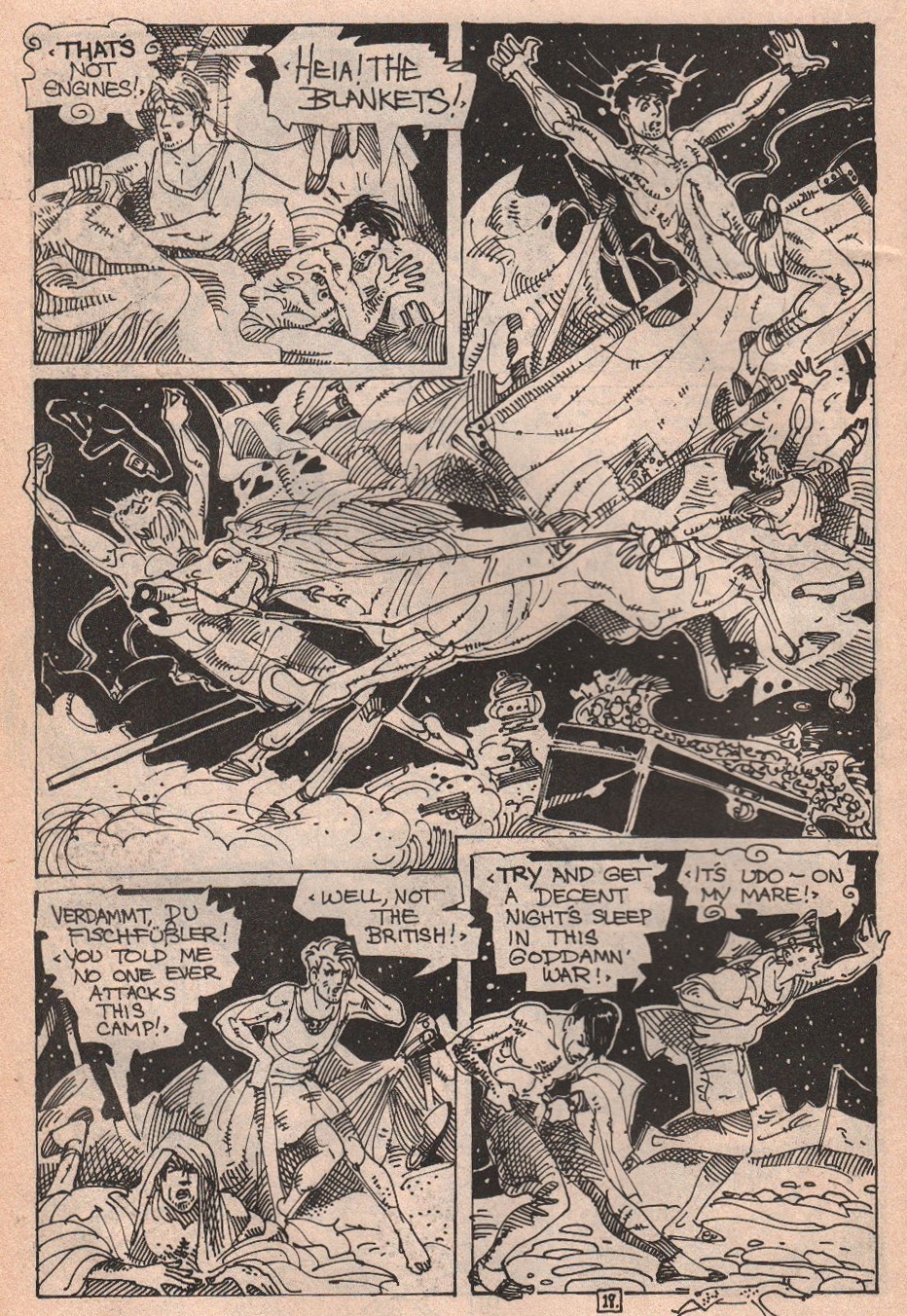
It’s a while since I’ve recommended a graphic novel so here is The Desert Peach by Donna Barr. Yes that is a Nazi uniform. Set during the Second World War, The Desert Peach follows the misadventures of Oberst Manfred Pfirsich Marie Rommel, the flamboyantly gay younger brother of Erwin Rommel, the Desert Fox, packed off to Africa for safety’s sake, kept under Rommel’s watchful eye and placed in charge of the 469th Halftrack, Gravedigging and Support Unit of the Afrika Korps. Pfirisch [German for Peach] is more concerned with keeping his men alive and out of trouble than anything else, hindered along the way by a fabulous cast of characters that read like the Dirty Dozen on crack – his sexually omnivorous lover, ace fighter pilot Rosen Kavalier, his grubby barrack room lawyer orderly, Udo Schmidt, an apparently mute radio operator who is always seen cradling a tiny stuffed dinosaur and Dobermann, ‘one bang too many’ explosives expert who has a pet landmine called Fridl.
The art looks rough at first glance but is vigorous and enthusiastic, superb facial expressions, spot on perspective when the author feels like it and all the vehicles are recognisable, if you feel the need to look them up. Donna Barr also draws gorgeous horses, something where many comic book artists fall short. {Link may be NSFW due to nudity, human not horse}
Sadly most of the early issues are now only available on Kindle [or paper if you can track down one of the original issues] but later issues are posted on the Desert Peach website.

comfy chairMy guest today is Larry Benjamin, Bronx-born wordsmith for whom writing is a way of life. Author of romance What Binds Us and short story collection Damaged Angels, Larry has agreed to visit today to talk about his new release Unbroken, a book with a very special meaning for Larry. I’ve been lucky enough to read it and can say that it impressed me very much.

Thanks, Larry, for visiting and for answering my questions.

###

Elin:  Can you tell me a little about yourself? For instance, do you have to have a day job as well as being a writer?
Larry:  While I’ve always been a writer—that is, I would write and stick my stories in a drawer (or later, a folder called “Larry’s writing” on my computer) —I got serious about it as a career a few years ago when both my partner and I ended up unemployed at the same time. I began to panic thinking I’d never get another job which lead me to wonder what else I was qualified to do. I dusted off the manuscript for What Binds Us and I was on my way. Returning to writing was like returning to a first love long lost.
Yes, I have a day job. I work in Corporate communications for a global chemical company. So writing is both my vocation and my avocation.

Elin: When you aren’t writing, is there any other creative activity you enjoy? Have you ever written about it?

Larry:  Besides writing, I’m absolutely passionate about houses. We’re 6 years into the 5-year renovation of our current house (the 5-year plan on our previous house actually took eight). And most weekends you can find us attending open houses in our favorite neighborhoods. Realtors don’t even make us sign the visitor’s book anymore.
Readers can pick up on my obsession with houses and their furnishings in my descriptions of both in my books.

Elin:  What are you reading? Fiction or non-fiction?

Larry:  I’m currently reading Gerald Durrell’s My Family and other Animals, which is unusual for me because generally I tend to stick to fiction as I find reality to be overrated and often grim. I’m loving the book, though, because the story is quite hilariously told and the writing is very fine.

Elin:  In that crucial inspiration stage of a new story, for instance Unbroken, which comes first? Plot, situation or character?

Larry:  Because my stories are heavily character-driven the characters tend to come first. However, I started writing Unbroken, just after I came across a tweet that asked: when was the moment you first knew you were gay? For me the moment occurred when I was in seventh grade. I was 12. He was the new kid. Jose. One look at him and I knew, absolutely knew I was gay. So in the case of Unbroken, the situation came first. Everything else was built on that defining moment.

Elin:  Do your characters arrive fully fledged and ready to fly or do they develop as you work with them?

Larry:  It depends. Dondi in What Binds Us arrived in my head fully formed and he never really changed. Unbroken spans 40 years. Lincoln, the main character, is first introduced as a 6-year-old so he definitely developed as I wrote. Same with the other main character, Jose. Lincoln first meets Jose when they are both twelve. He is the new kid in school so a complete unknown. As the story progresses, Jose’s personality is revealed and we watch him grow and mature as struggles to understand himself and the world around him. For me the most astonishing character in Unbroken was Jose’s sister, Maritza. She was meant to be a very minor character but she kept nagging me and whispering her story. I was routinely getting up in the middle of the night and writing out more of her story, which surprised me at every turn. In the end she became the first fully formed female character I’ve ever written.

Elin:  Do you have a crisp mental picture of them or are they more a thought and a feeling than an image?

Larry:  I generally know what the characters look like but little else at the beginning. I have a feeling for who they are as people but I find by relaxing and listening really hard they will tell me who they are as they reveal their story to me. I don’t outline, or plot out my stories in detail, in advance of writing, I just sort of write. For me writing is an organic—and chaotic—experience.

Elin:  Is there any genre you would love to write, ditto one you would avoid like a rattlesnake?

Larry:  You know when I was submitting Unbroken for consideration for publication, I had to identify its genre. That was a struggle because I tend not to think about what genre I’m writing in. I just write because I have a story I want to tell. Unbroken is part gay romance, part coming of age novel, part love letter to the boy I fell in love with at twelve.
The other day, I came across a reader’s review of What Binds Us and she said, “Yes, it’s love story but really so much more than that. More like a life story.” A life story. I absolutely love that description.

Elin:  When you were writing Unbroken, was there a point where you felt you should pull back a little because you were putting too much of yourself into it?

Larry:  Oh yeah. I tend to reach that point with all my books. My books are all fiction but they are firmly rooted in my experiences. I’m an emotional writer and that emotion is grounded in truth.
With the writing of Unbroken, I had to revisit my past: the bullying, my parents’ disappointment, the innocent longing for a boy I barely knew─It was a painful part of my history and documenting it was to revive that long-forgotten pain, to show a side of me—part hopeful, part stupid—I wasn’t sure I wanted anyone to see. In the end the struggle to share the truth won out.
When I set out to write the book, I didn’t want to just tell the story of one boy’s love for another, I wanted to share details of a first crush and what it’s like to discover the world thinks you’re wrong in that love, thinks that you’re broken. So yes there’s a lot of me in Lincoln, a lot of my own truth in Unbroken. And I wouldn’t have it any other way.

Elin:  Put together your ideal team of men/women – drawing from all and any walks of life, fictional or non-fictional – who you would want to come to your rescue if menaced by muggers/alligators/fundamentalists?

Larry:  That team would consist of William Morgan—Gar—from my friend Andrew Q. Gordon’s remarkable fantasy novel, Purpose. Gar is strong, extremely rational and practically bullet-proof. Plus he can read and manipulate minds. Second on the team would be Toby, my 9-year old silky terrier.

Toby the Fierce

He’s small but fiercely loyal and extremely protective. And finally Matt Damon. He was, after all, Jason Bourne in the Bourne trilogy; I’m sure he picked up some useful skills from playing that part. Plus he looks like…well…like he does. 😉

Elin:  Villains are incredibly important in fiction since they challenge the main protagonists and give them something to contend with beyond the tension of a developing relationship. What sort of villains do you prize?

I prefer villains who aren’t purely evil, who have some trace of humanity. I also like to believe that every character can become a villain for a moment in a particular situation. In Unbroken, there are many, many villains but only in the sense they give the main protagonists something to contend with, they are the people Lincoln and Jose must battle in their journey to be their authentic selves—parents and petty bullies. And for that reason the villains are unexpected, people well meaning in their own way but narrow minded, some are cruel, others, afraid.
Sometimes though, at least for me, villains aren’t people. In What Binds Us, the main villain was the HIV virus. In Damaged Angels the villain was drugs and desperation and mental illness. In addition to the “people villains” in Unbroken, there is also the villain of internalized homophobia which can makes Lincoln believe he is broken.

Elin:  What are you working on at the moment? Can you discuss it or do you prefer to keep it a secret until it’s finished.

Anyone who knows me knows I am terrible at keeping secrets. When I’m working on something I start talking about it right away. I’m not writing anything at the moment. When I finish a book, I find I need a “fallow” period to rest, to recover, to just be. Then at some point, an idea will form, or a character will introduce himself and I’m off.

Elin:  Could we please have an excerpt of something?
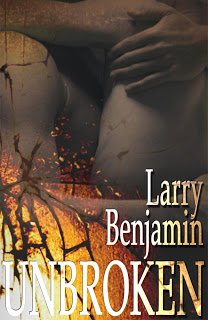
Here’s an excerpt from Unbroken

Brainiac
They hurled words like stones: “Brainiac. Sissy. Faggot.”
I sat on the ground, surrounded by a circle of boys bigger and tougher than I. They’d taken my glasses so I couldn’t see. I could only sit there helplessly, trying not to cry, trying not to hear the names they called me.
I let myself go silent in defense, refusing to acknowledge the hateful words: Brainiac. Sissy. Faggot. I refused to acknowledge their hostility, this hostility, this constant hostility, which seemed to be driven less by the fact that I was almost certainly gay, than by the fact I had never denied their accusations. I knew instinctively that to deny, to lie, was to agree they were right, I was wrong, I was broken. That I would not, could not, do.
Looking back, I realize I’d let them, those savage boys whom I did not know or care about, silence me, take my voice away. It would take years, but I would find my voice. I would learn to make myself heard over the sounds of war.
“Hey,” Jose shouted suddenly. “Hey!” I couldn’t see him through the circle of boys, but I recognized his voice, that deep, thunderous rumble.
“Come on,” I heard Elsie say. “It’s just that faggot. This happens to him all the time. He’ll be fine.”
She’d known me since fourth grade yet still, to her, I was “just that faggot.” “My name is Lincoln,” I wanted to shout. “You’ve known me since fourth grade.” Instead I remained on the ground fighting new tears.
Jose pushed through the circle of boys. “Leave him alone.”
He must have seen my raw, naked face for he turned to the boy holding my glasses. “Are those his?” he asked, pulling them out of his hands. “Get lost!”
The boy, surprised, shrugged as if it made no difference to him, and he and his posse of tyrants turned and walked away.
Jose crouched beside me; bouncing on the balls of his feet, he looked at my scattered books, my knapsack open, empty. His eyes went soft, dark with concern. He turned, and said something to Elsie. Then to me, “You okay?”
I nodded, tried to smile, cried instead.
“Hey,” he snapped.
“What?” Elsie popped her gum, stared at him.
“I said, give me a tissue.”
She sucked her teeth, reached into her purse and handed him a single tissue as if it were her last dollar. He glared at her, dark eyes flashing. She reluctantly handed him a handful more which he gave to me. “Dry your eyes and blow your nose,” he instructed me.
I did as I was told.
“You okay?” he asked again, handing me my glasses. I took them from him, put them on.
“Better now,” I said trying to smile.
The boys gone, Elsie moved closer, hovering at the edge of our interaction. Her eyes darted around; she looked everywhere but at me. She appeared less concerned about returning danger than about witnesses to this.
“Okay,” Jose said. “Let’s get your books, and we’ll walk you to the bus stop.” He glanced at Elsie who said nothing.
At the bus stop, Elsie sulked on a bench, again looking everywhere but at me. Jose talked to me of little things: did I understand that Shakespeare passage we’d read in English today? Why does the cafeteria always smell of fish?
Finally the bus came and we were each released from his prison.
“Thanks,” I said as the bus drew to a halt. I was reluctant to leave him, my dashing young hero, but happy to put the day’s events behind me.

###
Unbroken

Blurb:
My parents, unable to change me, had instead, silenced me. When they’d stilled my hands, they’d taken my words, made me lower my voice to a whisper. Later I remained silent in defense, refusing to acknowledge the hateful words: Brainiac. Sissy. Antiman. Faggot.

Lincoln de Chabert’s life is pretty unremarkable until he comes home from kindergarten and announces he will marry his best friend, Orlando, when he grows up. His parents spring into immediate action, determined to fix him―his father takes him to baseball games and the movie “Patton”―igniting an epic battle of wills as Lincoln is determined to remain himself, and marry whom he chooses, at all costs.

Unbroken is available now from Amazon in paperback and Kindle. Barnes and Noble in paperback and Nook, and from Smashwords in all ebook formats.

You may follow Larry here:
Facebook: https://www.facebook.com/AuthorLarryBenjamin
Twitter: https://twitter.com/WriterLarry
Blog: http://authorlarrybenjamin.blogspot.com/

My guest today is Dominica Malcolm, born in Australia, living in Malaya and incredibly well travelled. She describes herself as a ‘creative explorer’ having performed stand up comedy, written plays and screen plays, short stories, a novel and non-fiction, been a travel photographer and she cherishes an ambition to perform a one-person show. She is here today to talk abut her first novel, Adrift, a super combination of time travel and lady pirates which is released TODAY.

Welcome, Dominica.

Elin : Can you tell me a little about yourself? For instance, do you have to have a day job as well as being a writer?

Dominica : When filling out immigration forms, I always write “Housewife” – I’m a stay-at-home mother, which has been my primary role for the last 6 or so years. But in the past I’ve been paid as a stand-up comedian, web developer, and videographer/editor, amongst other things.

Elin : When you aren’t writing, is there any other creative activity you enjoy? Have you ever written about it?

Dominica : It varies depending on mood. I’ve delved into a number of creative pursuits. At the moment, though, as I’ve just recently attended a “comedy bootcamp”, the plan is to try and get back into performing stand-up comedy, as well as finish off editing a music video that I filmed in Hawaii in February 2012. I’d love to do more film stuff and improvisational comedy, but it’s harder for me to organise creative activities that involve other people.

Elin : Can you name any author/authors, past or present, who have been a great influence on your work?

Dominica :I think that I’ve been more influenced by friends who are writers, rather than well known authors. People can look up the two I dedicated Adrift to – Jeremiah Murphy and Sally Bell. I love their work.

Elin : What are you reading? Something to be clutched to the bosom or tossed aside with force? Fiction or non-fiction?

Dominica : I’m in the middle of a few different books, but I’ll just list three.
1. The Fantastical Life of Serenity by Serenity Valle, which is a collection of short fiction.
2. I Too Had a Love Story by Ravinder Singh, which I believe is non-fiction/memoir, even though the back of the book labels it as fiction.
3. The Boy in the Dress by David Walliams, which I’ve been reading to my eldest son when he’s actually wanted me to.

Elin : Are you a plotter or a pantser?

Dominica : It depends what I’m writing. I tend to be a panther when it comes to short fiction, but I’ve never been able to finish anything particularly long that way. Adrift started out with me writing bits and pieces all over the place, but I eventually realised I had to come up with the overall plot before I wrote too much, or else I wouldn’t finish it, or at the very least probably wouldn’t have the kind of story I wanted. I have another novel that I plotted out not long after I plotted Adrift, which started out similarly. It’s nice to know I have a structure there waiting for me when I have time to go back to it.

Elin : Do your characters arrive fully fledged and ready to fly or do they develop as you work with them?

Dominica : They tend to develop as I work with them. I enjoy seeing how they respond to certain situations that I throw at them, because I don’t always know how that’s going to go. It makes writing more fun for me.

Elin : Do you have a crisp mental picture of your characters or are they more a thought and a feeling than an image?

Dominica : I think by the time I’ve finished writing them, I have a fairly clear picture of them, even if I don’t go into too much detail about what they look like for my readers.

Elin : Do you find there to be a lot of structural differences between a relationship driven story and one where the romance is a sub plot?

Dominica : Structure implies rules, and I don’t really believe in rules when it comes to writing. If people want to write something different from expectations – what others believe the structure should be – they should be free to do so.

Elin : Put together your ideal team of men – drawing from all and any walks of life, fictional or non-fictional – who you would want to come to your rescue if menaced by muggers/alligators/fundamentalists?

Dominica : Ah, let’s see. Wolverine from the X-Men. Steve McGarratt from Hawaii Five-O (new series). The Doctor (preferably Five or Ten) from Doctor Who. Do they have to be men? Buffy and Faith from Buffy the Vampire Slayer. River from Firefly.

I want her on my team

Elin : Villains – incredibly important in fiction since they challenge the main protagonists and give them something to contend with beyond the tension of a developing relationship. What sort of villains do you prize? A moustache-twirling nightmare or … ?

Dominica : I like villains who are well developed – shades of grey, so they may have features audiences can identify with in a way. Characters that aren’t just caricatures, stereotypes, or seen as pure evil.

Elin : What are you working on at the moment? Can you discuss it or do you prefer to keep it a secret until it’s finished.

Dominica : I suppose the biggest projects would be a collection of mermaid short stories, which is a spin-off from Adrift, called Losing Prudence. Some of the stories I’ve already written have been published elsewhere, such as “Siren” which appears in Fae Fatales: A Fantasy Noir Anthology.

I’m also putting together an anthology of speculative fiction set in the Asia-Pacific region over at Solarwyrm Press (http://solarwyrm.com). Submissions close November 30, and I love seeing new submissions!

Elin : Could we please have an excerpt of something?

Dominica : An excerpt from Adrift:

“What year is this?”

“Two-thousand and eleven,” Dick says automatically, before realising the absurdity of the question.

Jaclyn bolts upright and runs out the door into the open hallway to look down at the street. Thinking this might be the best opportunity to lock her out of the room, Dick quickly follows her.

Unfortunately he doesn’t reach the door in time, and Jaclyn barges past him again, asking herself, “Three hundred and fifty years?”

Jaclyn is back at the window before Dick can say, “Eh?”

There’s a long silence before Jaclyn looks at Dick again. “When I awoke this morning, it was sixteen sixty-one.”

“Wait a minute,” Dick says, observing her with a skeptical eye, “let me get this straight… you’re saying you’re a time-traveller?”

“I am not sure what you mean by that,” Jaclyn says. “All I know is what I was doing in Bridgetown this morning, before finding myself here.”

“Are you having me on?” Dick asks. “Like, are you some actor who is out here for some fan convention and you’re… what’s the word? Method acting?”

“Preposterous! I have never heard of women actors. That is absurd.”

“And travelling through time isn’t?” Dick asks.

“Yes, I concede you may have a point there. Well, you could simply decide that I am insane… but what if I am not?”

###

Adrift

Blurb:
It’s the 21st century, and Jaclyn Rousseau is not where she should be. 1661 disappeared before her eyes, and there’s no way home. That matters not to Jaclyn—she lost her lover, and everything else that meant anything to her, in the West Indies.

In an adventure that crosses time and the Atlantic, a murderous pirate must find a place for herself in this new world.

Can she escape her past, or will it catch up with her?

Adrift (paperback) on Amazon: http://www.amazon.com/Adrift-Dominica-Malcolm/dp/0980508428/ref=sr_1_2?s=books&ie=UTF8&qid=1378974245&sr=1-2

Details for where else to get it: http://dominica.malcolm.id.au/writing/adrift

Fae Fatales: A Fantast Noir Anthology on Amazon: http://www.amazon.com/Fae-Fatales-Fantasy-Anthology-Colour/dp/0473243172/ref=sr_1_1?s=books&ie=UTF8&qid=1378974245&sr=1-1

Blog/web site: http://dominica.malcolm.id.au

Facebook: http://www.facebook.com/DominicaMalcolm

Twitter: http://www.twitter.com/dommalcolm

Books and Museums

Two subjects very close to my heart. Who doesn’t get a little hot under the collar at the thought of incunabulae, grimoires and morocco bound folios?

Surely it’s not only me?

*sigh*

Some people like to dwell on photographs of young men wearing a hat and little else in order to show off a musculature as defined as an anatomical drawing , but a closed book offers far more in the way of mental stimulation, as far as I’m concerned. Also the dust jacket can be ripped and the inside filled with scrawly notations but that just makes the thing more interesting. AND you don’t have to worry about hurting its feelings or it hurting yours. Books don’t judge. Best companions ever whether hand written on vellum or $0.99 on Smashwords.

And I love museums too so was very happy to spot not one but 2 cracking book based exhibitions reviewed in the Museum’s Journal this month.

“This is what we do for the dying …” by Johnny Kelly

Memory Palace, at the V&A, is a temporary art exhibition based on a novel specially written for the event by Hari Kunzru. Memory Palace describes a dystopian future where all forms of learning and the recording of information have been banned. 20 artists were each given a different excerpt of the novel and asked to interpret it in their own way. Here is a video describing the process of putting the exhibition together.

If you’re in London before the 20th October why not take a look.

The other exhibition is open until the 27th October at the Bodleian Library in Oxford and has the delightful title “Magical Books: From the Middle Ages to Middle Earth”.

In it, parallels are drawn between the work of British fantasy writers and ancient texts from the library collection.

Fragment of the Book of Mazarbul made by J RR Tolkein in the 1940s

The Ashburnham Fragment is paired off with Tolkein’s own facsimile of the Book of Mazarbul, while C S Lewis’s description of Narnia echoes elements of the Ripley Scroll.

This 20 feet by 2 feet scroll describes in glorious illustrated detail the steps required to make the Philosopher’s Stone! Other modern authors are Alan Garner [The Weirdstone of Brisingamen], Susan Cooper [The Dark is Rising story cycle – please ignore the film, it was rubbish] and Philip Pullman [His Dark Materials]. You can also see the First Folio Macbeth, in the witchcraft section, and that’s not something you’ll see anywhere else.

Hump Day Hook

 I lost the plot a bit last week and it was Wednesday morning before I remembered that I should have done HDH. Silly me. This week I’ve done it in plenty of time and plan to be a bit more efficient about getting round to register my presence. I read all the entries last week – lots of cool stuff – but was too dopey to comment.

Anyhow! This week I’m using the usual ancient bit of fiction, for which I don’t have a proper title, but if I did it would probably have been something like “The Rake and the Bluestocking” just so people knew what they were getting. Blame Mills and Boon. I read a couple and thought “Pffft, I could do that” so I tried  – and failed because I was far more interested in breeches than bodices. And THIS week that’s what you’re getting – the hero.

We left Aubrey and Cicely hatching plot to make Mad Pat uncomfortable. This is what Pat is doing:

Just as Aubrey was seating himself at Cicely’s desk, her betrothed was groaning his way to consciousness while his valet attempted to repair the wreck of his room.

“I can’t understand it myself,” the man was saying. “I just can’t see where the attraction lies in going out and getting puking drunk three nights out of four. Mark my words, lad, you’ll end up like your cousin Kevin – screaming your nights away in a madhouse. The first time you wake me up to tell me your feet have been eaten off by funny green things out of the wall, that’s it, I’m off home to Sligo.”

“Shut up, Phelim,” muttered a hummock amongst the tangled debris of a four-poster bed. “Faith, I need a drink.”

“No you don’t,” Phelim snapped. “You need to get up and clean and dressed. A pint of coffee, a cut of beef and a canter in the Park’s what you need.”

“If you don’t shut up you’ll be needing a doctor.”

“And another thing! How can you expect any decent woman to live in this Bedlam? Half your servants speak Gaelic, the other half speak Pushtu and the cook’s Chinese. Honest to God, it’s like the Tower of Babel in the servant’s hall.”

The hummock erupted with a roar. “Phelim, do you want my boots down your throat? My God, I’ve still got them on! Couldn’t you at least have undressed me, you lazy bastard?”

“Undressed you? The state you were in nobody wanted to touch you. We paid the crossing sweeper who brought you home to carry you up the stairs – well, more drag really, he was only a little feller.”

Ah full of sweetness and light. Tune in next week to learn more about our gracious hero.

Doodle Tuesday

For the past few weeks I have been contributing to the #DoodleTuesday group on Facebook. This group has been set up in support of the You Will Rise Project which aims to provide a means by which people who have been bullied, either as children or as adults, can express their experiences in any artistic means they choose. The project was started by Linda Regula and Paul Richmond, both of whom were bullied as children, and they have been joined by artist Aaron Anderson, videographer Maria Fanning and Brooke Albrecht, the Doodle Queen.

My doodles are nothing special but some of the drawings and photo manips are fantastic and well worth sharing. So see what people posted last week and if you would like to join in you can link to your drawing from Twitter, via Instagram [not sure what that is], the Doodle Tuesday and You Will Rise Facebook groups and I should imagine Tumblr as well. Just add #doodletuesday to your post to show your support of this project.


Anything Could Happen

Blurb: Moving to Kansas City could be the best thing Austin Shelbourne has ever done. For a start, he can stop living a lie and finally come out of the closet. And there’s a chance, though slim, that he might be able to locate the love of his life, Todd Burton. It had seemed like a good idea when he seduced his friend, but Todd freaked out and vanished. Austin hopes to find Todd, make things right between them, and win his love. But when he meets actor Guy Campbell, things get even more confusing.

The moment Guy sets eyes on Austin, he knows Austin is The One. But Austin makes it clear he feels a responsibility to Todd, and Guy has some dark secrets of his own. He’s found redemption in acting and directing, but worries that if Austin learns the truth, he might not be able bear it. And what if Todd accepts Austin’s apology and the love Austin offers? Guy wants Austin desperately, but he also wants him to be happy. In the play of life, with the happiness of good men in the balance, anything could happen.

Buy from Amazon: http://www.amazon.com/Anything-Could-Happen-ebook/dp/B00F27BEV0/ref=zg_bs_14044691_5

Buy from Dreamspinner Press: http://www.dreamspinnerpress.com/store/advanced_search_result.php?keywords=Anything+Could+Happen&osCsid=c7tgdokg6qh341j67rembsaf25&x=22

Excerpt:  Continue Reading »